Microsoft and more than 40 organizations present a transparency initiative for AI models and agents
IA en un minuto newsroom · Editor: Jon Elgezabal
In 30 seconds
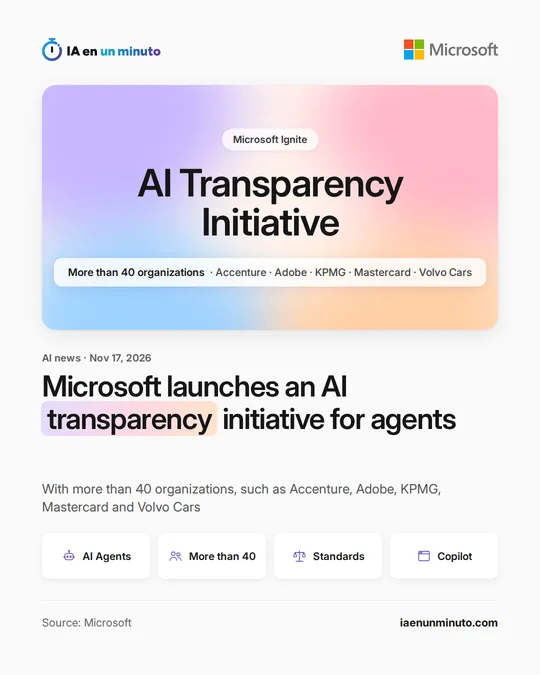
Microsoft is launching at Ignite a joint plan with more than 40 organizations so that any company can audit what its AI agents do. Adobe, KPMG, Accenture, Volvo Cars and Mastercard are among the partners that will help define shared rules valid for any model. Copilot and Foundry will get that work later on, although the company has not yet set a date.
Microsoft wants companies to be able to check on their own what their AI agents do, without depending only on what the model itself says about itself.
Satya Nadella, the company's chairman and CEO, presented the AI Transparency Initiative on Tuesday, November 17, at the Ignite conference. Microsoft is driving it with more than 40 organizations, among them Volvo Cars, Mastercard, KPMG, Adobe and Accenture, and the aim is to set open standards for transparency, security and governance that hold whatever the model or provider, whether it is a closed model or an open-weight one.
According to Microsoft's release, companies already plug models into data, tools, credentials and infrastructure, and agents act without a person signing off on each step. Today's controls see much of what goes on around the model, but not what happens inside it, and they cannot check what the agent claims to have done. The company likens an agent holding credentials to a highly privileged employee working at machine speed.
The initiative has three parts: more involvement by Microsoft in the agent standards work of NIST, the US standards institute; the collaboration with those organizations; and bringing the result to Microsoft AI, Microsoft Foundry and Copilot, its AI assistant, so customers can use those records with their own security and compliance tools, whether or not they come from Microsoft.
Microsoft sums it up in three ideas: see what the agent was asked, which model it used, what data it touched and what it did; verify that activity with the organization's own systems; and control what it may do before it acts. According to the company, responsibility still lies with each organization.
The release gives no dates or prices, and anyone who wants to follow the initiative can sign up on Microsoft's website. Its principle: the more autonomy AI has, the more transparency it needs.
Why it matters · analysis and opinion
The problem Microsoft describes is real: an agent acting on its own leaves a trail that, today, is mostly told by the agent itself. What matters is that the answer is framed as an open standard and not as a feature exclusive to its products, because companies mix models from several providers and do not want to rebuild their controls every time they switch. What is missing is what decides whether this works: what format those records will have, who will back them and when they will arrive. In the meantime, anyone already using agents with access to data or credentials can get ahead with the basics: minimal permissions, human confirmation for sensitive actions and records kept outside the agent.
Official source: Microsoft · Written with the help of AI: how we make the news
What does it mean for your business? · analysis and opinion
For now, nothing changes in the tools that are already in use: Microsoft has not given dates or details of how this work will reach Copilot, Microsoft Foundry and its other products. The ones most interested, in Spain and Latin America, are companies that already have Copilot or agents connected to email, documents, accounts or other tools. Anyone who only uses a chatbot to write text will barely notice a difference.
The useful idea behind this is that responsibility stays with the company, not with the model, and there is no need to wait for any standard to apply it. Our advice: make a list of the agents and automations that access data, tools or credentials; give them only the permissions they truly need; require human confirmation before actions with consequences, such as payments, messages sent to customers or deletions; and keep records of their activity outside the agent itself, so as not to depend on what it says about itself.
Almost all of this is free and is simply a matter of order. The risk of not doing it is that an agent with credentials acts like an employee with many privileges, but much faster, and without its own records it is difficult to explain what happened to a customer or an auditor. The prudent approach is not to assume that these guarantees will reach products soon.