A coalition of scientists and tech figures accuses Anthropic of not being a safe AI company ahead of its IPO
IA en un minuto newsroom · Editor: Jon Elgezabal
In 30 seconds
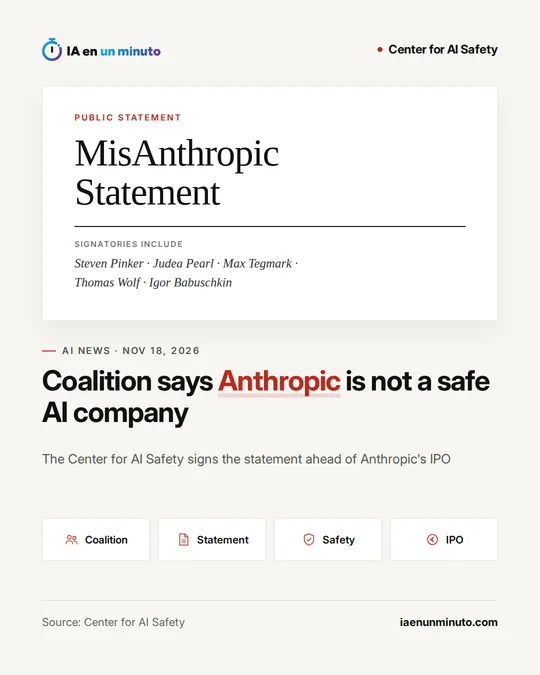
Anthropic, on the verge of its stock market debut, faces a declaration signed by the Center for AI Safety and by names such as Judea Pearl, Max Tegmark and Steven Pinker. According to the signatories, the company boasts about safety while racing to create an AI that perfects itself. The coalition also faults it for scaling back its commitments in February and for lobbying against several AI laws.
Scientists, legal scholars and tech figures have put their names to one shared text against Anthropic.
The Center for AI Safety (CAIS), a San Francisco nonprofit that researches and campaigns on the risks of advanced AI, added its signature on November 18 to the MisAnthropic Statement, a public declaration posted on its own website. It made the announcement in a press release distributed by Business Wire and carried by Yahoo Finance UK, with Anthropic about to go public.
The declaration argues that "Anthropic is not a safe AI company". According to the text, the company warns that an AI able to improve itself could concentrate power and slip out of human control, yet it still competes to be the first to build one, and it leans on its safety image to win over investors, staff and the general public.
The signatories range from AI safety researchers and open-source advocates to ethics specialists and accelerationists, groups that rarely agree on anything. They include Harvard psychologist Steven Pinker and Harvard economics Nobel laureate Oliver Hart; Turing Award winner Judea Pearl; legal scholars Lawrence Lessig and Laurence Tribe; MIT's Max Tegmark; Thomas Wolf, of Hugging Face; xAI co-founder Igor Babuschkin; George Hotz, Guillaume Verdon and Tristan Harris; and Fields medalists David Mumford, Peter Scholze and James Maynard.
The text accuses the company of having watered down its Responsible Scaling Policy (its safety commitments) in February, to the point of dropping entirely its unilateral pledge to pause development. It also says Anthropic pushed to soften SB 1047, the RAISE Act and the AEGIS Act, and argued behind closed doors that federal law should override state AI laws.
Dan Hendrycks, executive director of CAIS, says in the release that the company cannot present itself as safe while scaling back its earlier commitments and asking the public for tens of billions of dollars to build that kind of AI.
These are accusations from the coalition. The release includes no response from Anthropic.
Why it matters · analysis and opinion
Going public forces Anthropic to explain its risks to a kind of investor it did not have until now, and this declaration lands right in the middle of that conversation. What stands out is not the criticism itself but who signs it together: people who want to speed AI up and people who want to slow it down. Safety has been one of the company's arguments against its rivals; if that argument is disputed in public, it loses some of its weight. Anyone using Claude at work has no reason to change anything because of a manifesto, but it is worth following two things: how Anthropic responds and what its IPO documents say about its safety commitments.
Source: Yahoo Finance UK · Written with the help of AI: how we make the news