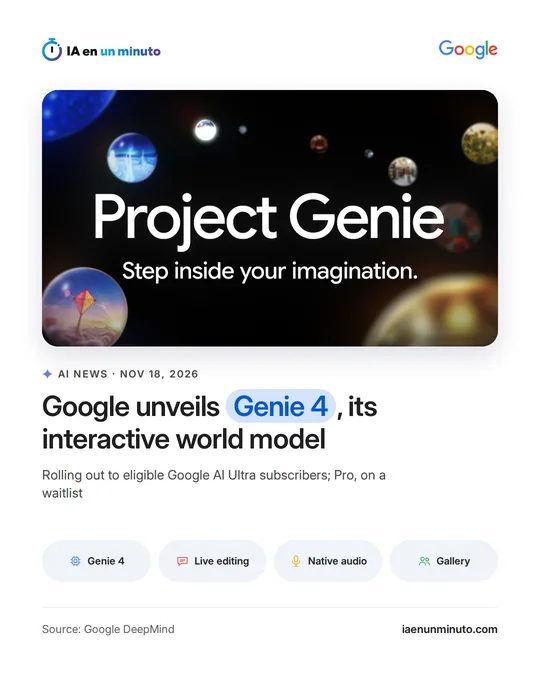
Google DeepMind begins rolling out Genie 4, its interactive world model, to eligible Google AI Ultra subscribers
IA en un minuto newsroom · Editor: Jon Elgezabal
In 30 seconds
Google DeepMind is opening Genie 4 to some Google AI Ultra subscribers, while Pro members wait their turn on a list. Project Genie now lets people alter the world by typing as they explore, and the model adds sound generated on the spot. Genie 3 goes from 60 seconds to 3 minutes per generation, alongside a conversational agent and a community gallery.
Google DeepMind has started opening up Genie 4, which it calls its most realistic and interactive world model, to eligible Google AI Ultra subscribers. It comes inside Project Genie, the experimental research prototype used to generate interactive worlds and move around them from a web browser. People on Google AI Pro can put their names on a waitlist on the same page.
The model was announced on October 27, when Google gave it only to a small group of trusted testers and said Ultra would get it soon (October post).
The main change is that the world can be altered on the fly: while exploring, typing a new instruction is enough to make it rain, bring in a character or send the scene in another direction. Genie 4 also pairs the picture with its own sound generated in real time, from background ambience to the characters' dialogue, something it does for the first time.
Genie 3 is still available in the model picker for anyone who wants longer trips: each generation now lasts up to 3 minutes, compared with 60 seconds before, and several worlds can be chained together. It also takes 360-degree panoramic images as a starting point.
Project Genie adds an agent that builds the world out of a conversation and gives it a matching soundtrack, plus a gallery where the community posts its worlds for others to explore or change. All the video and audio produced carries the SynthID watermark.
Google DeepMind admits that both models are still research and that it is still working on issues such as camera lag, complex physical interactions, audio precision and keeping a scene consistent over time. The post gives no separate pricing and no list of countries.
Why it matters · analysis and opinion
Moving from a closed group of testers to paying subscribers is the step that turns a demo into a product that can be judged. What changes is control: you no longer generate a world and watch it, you steer it as it happens, which brings the tool closer to people prototyping games, training material or video settings. Even so, Google still calls it research and lists flaws that matter for serious use, such as lag or scenes that do not stay stable. For a small studio or agency, it makes sense to try it for sketching ideas and showing concepts to a client, not for producing final pieces. The watermark on everything it generates is also worth keeping in mind before publishing anything made with it.
Official source: Google DeepMind · Written with the help of AI: how we make the news