An OpenAI AI finds about 35 vulnerabilities in Apple products
IA en un minuto newsroom · Editor: Jon Elgezabal
In 30 seconds
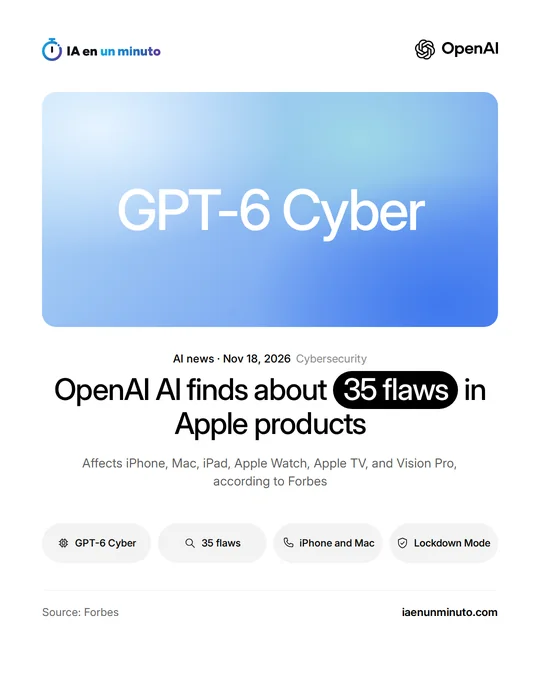
Calif, a cybersecurity firm, and OpenAI used GPT-6 Cyber to track down about 35 vulnerabilities spread across nearly every Apple device. Apple fixed a good share of them after the warning, according to Calif, though it has not replied to Forbes. Duong, of Calif, explains that AI makes hunting for flaws faster and advises keeping Lockdown Mode on even though his team got around part of it.
OpenAI and the cybersecurity firm Calif have found about 35 vulnerabilities in Apple products with GPT-6 Cyber, the AI model OpenAI unveiled on November 5, according to Forbes.
The flaws, of varying severity, were hunted down over recent months and affect almost the whole Apple range: iPhone, iPad, Mac, Apple TV, Apple Watch and Vision Pro. Some would let an attacker take over a phone or a computer through a malicious website. The researchers also wrote code able to get around part of the protections in Lockdown Mode, the iPhone option that limits some of its functions to reduce the risk of attacks.
Calif says Apple fixed many of the flaws after being warned. OpenAI confirmed that its model detected vulnerabilities and that Apple acknowledged the work, without giving further details. Apple had not responded to Forbes.
It is not the first time: in October, Calif had already used earlier OpenAI models to find flaws in PHP, a programming language common on websites, and several companies had to take their sites down for a while to fix them. When it launched GPT-6 Cyber, OpenAI said the model had found more than 2,000 bugs in Linux and prepared fixes for 948 of them.
Thai Duong, chief executive of Calif, told Forbes that the model finds flaws and writes the code to exploit them much faster than earlier ones, which helps those who defend systems but also those who attack them. According to Duong and Oege de Moor, founder of the cybersecurity company XBOW, AI speeds up that work but still needs specialists to direct the attack and check that the flaws are real. Duong still recommends Lockdown Mode: he says the findings do not make it less effective against many kinds of attack.
Why it matters · analysis and opinion
The finding says less about Apple than about the moment cybersecurity is going through: if a model lets a firm of researchers review almost a manufacturer's entire range in a few months, that same capability will be within reach of anyone who wants to attack. This time the result ended in patches, and Duong himself expects more flaws before models learn to fix them on their own. For any organization with Apple devices, the practical steps are the usual ones, but with less leeway: update as soon as a patch comes out, do not postpone restarts and treat links of doubtful origin with more suspicion. Anyone handling very sensitive information may want to consider Lockdown Mode, which Calif still recommends.
Source: Forbes Argentina · Written with the help of AI: how we make the news
What does it mean for your business? · analysis and opinion
This news affects any small business or freelancer that works with an iPhone, Mac or iPad: according to Calif, some of these flaws would let an attacker take control of the device just by opening a web page prepared for it. Thai Duong, the chief executive of Calif, also warns that, until AI models can generate patches on their own, he expects more bugs and vulnerabilities across the internet in general, not just on the iPhone. The sensible step is to install pending system updates on all of the company's Apple devices now, because Apple fixed many of the flaws after receiving the warning, and to leave automatic updates on so the business does not depend on every employee remembering. It is also worth checking whether older devices no longer receive updates and keeping them away from tasks involving customer data or banking. Duong still recommends Lockdown Mode, which limits some iPhone functions in exchange for more protection, even though his team bypassed part of its defenses; in our judgment, it makes most sense for the most exposed profiles, such as management or whoever handles payments. Our advice is to be extra careful with links that arrive by email or messaging apps. The cost is small: a few minutes per device and some inconvenience from the functions Lockdown Mode restricts. The risk of not doing it is a compromised phone or computer with access to the business email and documents.