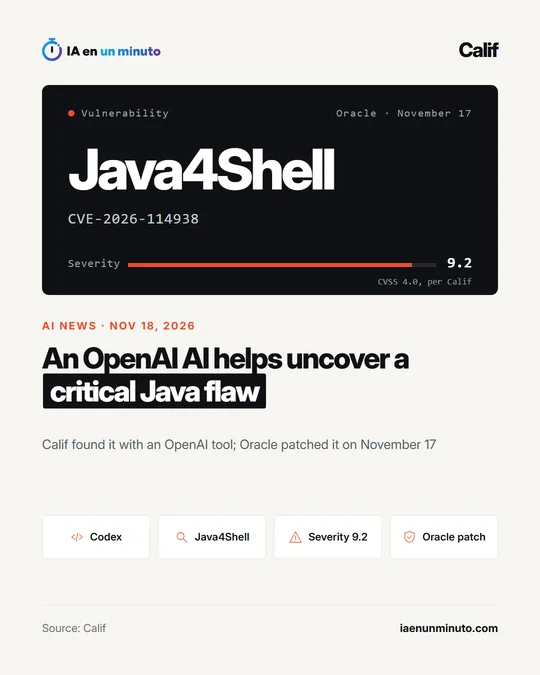
An OpenAI AI helps uncover a critical flaw in Java, which Oracle has already fixed
IA en un minuto newsroom · Editor: Jon Elgezabal
In 30 seconds
Calif used OpenAI's Codex to spot Java4Shell, a memory error in how OpenJDK decodes Base64 that opens the door to running someone else's code with no password. CISA is pressing everyone to install the fix OpenJDK and Oracle shipped on November 17, beginning with servers reachable online. ARM64 is safe: only x86-64 processors with AVX-512 VBMI are at risk, such as recent Intel Xeon or AMD from Zen 4.
Cybersecurity firm Calif has published the details of Java4Shell (CVE-2026-114938), a critical Java flaw that its researcher Quang Luong tracked down with help from Codex, OpenAI's coding tool. Luong writes that most of what Codex first came back with was useless, but as he kept pushing, the tool pointed him to memory corruption in the Base64 decoder.
The bug sits in an optimization inside OpenJDK HotSpot, the virtual machine of Java's open-source version, which relies on special processor instructions to decode Base64 faster. Badly formed Base64 text makes it write data beyond the memory it has reserved. The US cybersecurity agency, CISA, warns that deliberately crafted input can bring down the virtual machine and let an attacker run code remotely without logging in. Calif gives it a CVSS score of 9.2 out of 10, as reported by CyberScoop.
It affects OpenJDK from version 17.0.6 onward and the distributions built on it, among them Oracle GraalVM, Oracle Java SE, Red Hat OpenJDK, Azul Zulu, Eclipse Temurin, Microsoft Build of OpenJDK and Amazon Corretto. It can only be exploited on x86-64 processors that support AVX-512 VBMI, such as Intel Xeon chips from Ice Lake onward or AMD EPYC and Ryzen from Zen 4; ARM64 processors are not affected.
OpenJDK released its security advisory and Oracle its patch on November 17. CISA asks organizations to find every Java installation, including those that come inside third-party software, container images and appliances, and to patch as soon as possible, starting with systems reachable from the internet. In the meantime, Calif says the flaw can be mitigated by starting Java with hardware-accelerated Base64 or AVX-512 switched off.
Calif is holding back, for now, the attacks it built for specific products, and will release them once there has been time to update; it also stresses there is no one-size-fits-all exploit, as each target needs work of its own. According to CyberScoop, no real-world attacks had been reported when its article went out, and the flaw was not on CISA's catalog of exploited vulnerabilities.
Why it matters · analysis and opinion
The striking part is not just the flaw but how it was found: a researcher steering a coding tool through code as heavily reviewed as Java's. If hunting for serious bugs becomes this cheap, it will be cheap for attackers too, and the window between a patch and the first abuse tends to narrow. The practical problem is knowing where Java lives, because it often travels hidden inside third-party software, containers or devices that nobody records as such. That is why the first step is an inventory rather than a technical fix. Anyone who cannot update right away has startup mitigations, but they are a stopgap and one of them does not work on every architecture.
Official source: Calif · Written with the help of AI: how we make the news
What does it mean for your business? · analysis and opinion
This flaw does not only affect banks or public bodies. Any small business or freelancer running Java applications, such as a management program installed on its own server, an intranet or an online store built on that technology, may have an affected version if the server uses an x86-64 processor that supports AVX-512 VBMI. Those who only use third-party cloud services depend on their provider updating, and those who run no Java program have nothing to do. Our advice is to start with a simple inventory: ask the IT person or the company that looks after the systems for a list of which applications use Java, including those that carry it inside without showing it, and with which version. Then install the fixed version offered by each distribution, as Oracle and the CISA agency ask, starting with whatever is open to the internet. If a third party maintains the program, it is wise to ask them in writing to confirm they have already updated it. The cost is usually little more than a few hours of technical work and perhaps a restart outside business hours; the risk of not doing it is that someone runs code on those servers without needing a password. The fact that no attacks have been reported yet is no reason to delay, because with the patch out the flaw is far better known.