OpenAI begins safety assessments with four outside organizations: Apollo Research, METR, Transluce and Goodfire
IA en un minuto newsroom · Editor: Jon Elgezabal
In 30 seconds
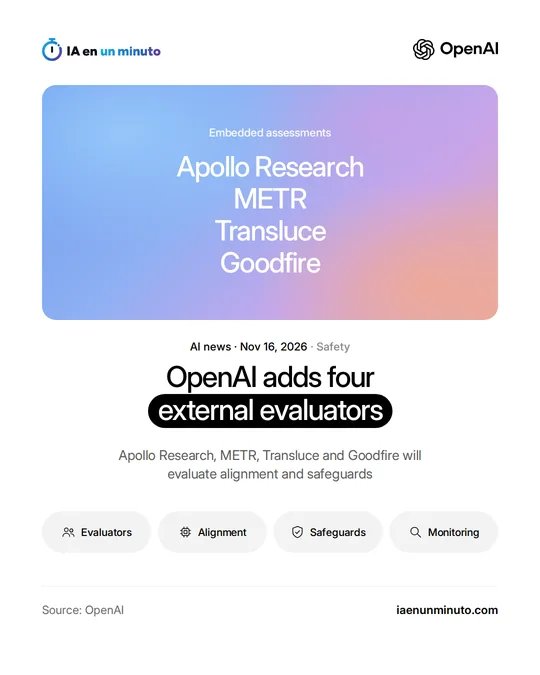
OpenAI is opening its internal models to four independent organizations so they can review its safety from the inside. METR, Goodfire, Apollo Research and Transluce will look at alignment and safeguards while models are trained and used within the company. Transluce and OpenAI also plan a second review, roughly eight weeks long, at the start of 2027.
OpenAI announced on Monday, November 16, that it has signed agreements with four independent assessors, Goodfire, Transluce, METR and Apollo Research, for the opening phase of what it calls embedded assessments. Under this scheme, experts from outside the company are given deep access to the lab's internal models and systems: depending on what each evaluation requires, that can mean source code, model checkpoints, monitoring systems, data used for training and evaluation, technical documents and talks with the researchers and engineers in charge.
According to the company, these first assessments center on alignment (whether models behave as intended) and on safeguards (the protections built into the models), both while models are being trained and while they are used internally. Each organization has a different brief.
Apollo Research will study whether models might secretly act against the intentions of the people who build them and whether OpenAI's safeguards would catch it; it will work in two stages, checking four claims, one of them being that training has not rewarded that kind of behavior. METR will look for misaligned behavior in the biggest reinforcement learning run OpenAI has carried out so far, including failures its current tests and monitors may have overlooked. The two sides have also preliminarily agreed on a second, broader review of the monitoring systems, with its scope still to be settled.
Transluce will examine how good and how complete the alignment tests that OpenAI applies after training are, and both plan another review of roughly eight weeks in early 2027, with access to more models. Goodfire will place interpretability researchers inside the project to analyze how the models work internally; its findings are aimed mainly at OpenAI's researchers, although it will also publish them as the collaboration moves forward.
OpenAI says the program builds on earlier work with outside evaluators, such as a pilot with METR on its internal monitoring systems. Assessors handling confidential information will work at OpenAI's offices and on company devices, and the Safety and Security Committee of the OpenAI Foundation board will receive the reports in full, without redactions. The assessors decide what they publish, but OpenAI keeps the right to strike out confidential information and may ask for findings that pose a risk to be held back until they are fixed.
The announcement sets no dates for the first public reports.
Why it matters · analysis and opinion
Until now, almost everything known about the safety of large models came from the labs themselves. Having outside evaluators see checkpoints, data and monitors from the inside changes who vouches for those claims, though not entirely: OpenAI picks the evaluators, agrees the scope with them and can strip out confidential material before anything is published. The real value will depend on what those reports end up saying and whether they include uncomfortable failures. For companies that use its models, the practical question is whether these reviews will one day provide guarantees that can be compared across providers. In the meantime, the sensible course is to keep asking each one for its safety documentation and not to mistake an announcement for an audit.
Official source: OpenAI · Written with the help of AI: how we make the news