Microsoft launches Perception, its AI agent cybersecurity platform to detect and fix threats
IA en un minuto newsroom · Editor: Jon Elgezabal
In 30 seconds
Microsoft now offers Perception with general availability, putting red, blue and green AI agents to work together to rehearse attacks, review alerts and repair flaws. Perception still keeps two agents in a testing phase, as well as its links to AWS, Okta, Salesforce and other tools. ISOC, the new operations center inside Defender, debuts its core features while the full SIEM waits.
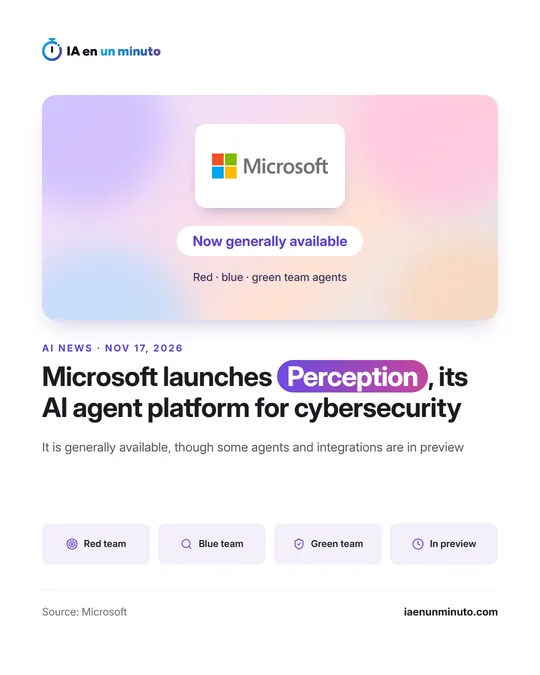
Microsoft said on Tuesday, November 17, at its Ignite 2026 conference, that Perception, its cybersecurity platform built on AI agents, has reached general availability. The same is not true of everything around it: two of its agents and the links to other vendors' tools are still in preview.
The company frames the launch around how quickly AI now finds and takes advantage of software flaws. It points to two critical remote code execution vulnerabilities in PHP disclosed this fall: nearly two weeks after they became public, about 29 million services were still exposed. It also notes that the CVE program has logged more than 96,000 vulnerabilities so far in 2026, over twice the roughly 40,000 of 2024.
Perception splits the work among agents from three teams, coordinated through playbooks in a closed loop. Red team agents rehearse attacks from the attacker's point of view before any breach happens; blue team agents spot threats, sort alerts and investigate incidents; and green team agents handle fixes and remediation.
Shipping as generally available are four blue team agents (Threat Intelligence, Alert Triage, Detection Authoring and Attack Investigation), the red team Recon agent and the green team Posture Prioritization agent. Still in preview are the Risk Reduction Agent (green, in public preview) and the Web App Pen Test Agent (red), along with launching playbooks from Defender, MCP and API connections to SIEM, SOAR and IT service management tools, and incoming signals from Salesforce, Okta and AWS. Perception's AI Readiness Initiatives will enter preview in January 2027.
According to Microsoft, each security team draws the boundaries and approves the highest-impact actions, and playbooks can start on their own when an incident matches the criteria that were set. The platform adds cost management dashboards and an estimator to follow AI consumption and anticipate spending. The announcement gives no pricing.
At the same time, Microsoft introduced ISOC (Integrated Security Operations Center) inside Microsoft Defender, a security operations center that combines SIEM (security information and event management) features, user and entity behavior analytics, threat intelligence and attack protection. Its main features are generally available. Eligible customers of Microsoft 365 E7, Microsoft 365 E5 and Defender Suite get every Microsoft Sentinel SIEM feature, 90 days of default retention for Defender data and more than 500 connectors; the full range of SIEM capabilities is in preview.
In the same post, Microsoft describes AI agents as "the new insiders": they are not malicious, but they work nonstop, at machine speed and with wide access to data, apps, tools and other agents, so they can get things wrong, be manipulated or end up compromised.
Why it matters · analysis and opinion
What is new is not that Microsoft has security agents, but that it now sells them as a finished product, coordinated with one another, from simulated attack to fix. For a small IT team, that promises to cover tasks that used to require dedicated analysts, but the fine print matters: the agents that touch systems the most, such as the risk reduction one or the web penetration testing one, are still in preview, as are the integrations with other vendors' products. Anyone already working with Defender can start with alert triage and investigation, which is what is ready, and decide beforehand which actions will require human approval. And each agent deserves the treatment of a privileged account: narrow permissions and a log of what it does.
Official source: Microsoft · Written with the help of AI: how we make the news