IA en un minutoNewsBusiness and products
Google turns to Blue Origin to put the first satellites of its space AI infrastructure into orbit
IA en un minuto newsroom · Editor: Jon Elgezabal
In 30 seconds
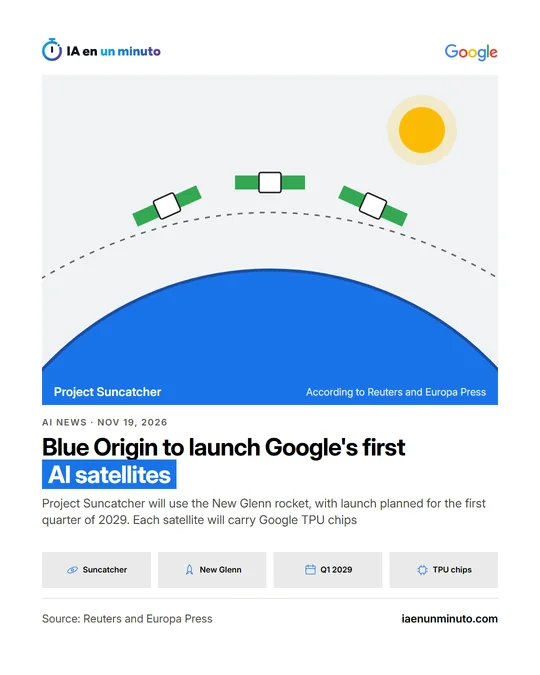
Google has chosen Blue Origin's New Glenn to send several satellites from its Project Suncatcher experiment into space in early 2029. Each will carry TPU chips with power similar to a server rack. SpaceX put the first prototype into orbit in October, and according to Google and Planet Labs it is responding as expected.
Blue Origin, Jeff Bezos' space company, will use its New Glenn rocket to launch the first satellites of Project Suncatcher, Google's experiment to run AI systems in space. Blue Origin itself announced it on Thursday, November 19, according to Reuters, in a report carried by BusinessDay. The flight is planned for the first quarter of 2029.
It will be the first heavy-lift mission Google devotes to Suncatcher and will carry several computing satellites; Reuters gives neither an exact number nor any costs. Each satellite will be fitted with TPUs, the chips Google designs to run AI programs, and will have computing capacity of roughly one server rack in a conventional data centre.
Google and Planet Labs put the first Suncatcher prototype into orbit in October, aboard a SpaceX rocket, and the satellite was working as planned after making contact. Other companies, such as SpaceX itself and the start-up Starcloud, are also looking at orbital data centres as AI drives up demand for computing. Experts cited by Reuters warn that expensive launches, engineering challenges and scarce satellite production could leave these centres years away from commercial use.
For Blue Origin, the deal secures a major mission for New Glenn after several delays and a launchpad explosion in May.
Why it matters · analysis and opinion
The search for computing capacity for AI has already led big tech companies to look beyond Earth, and choosing who launches each mission is part of that competition. Google entrusting this flight to Blue Origin, when SpaceX also aims to build its own orbital data centres, can be read as a way of not depending on a single supplier that also competes on the same ground. For companies that buy cloud services nothing changes in the short term: it is an experiment and experts place commercial use years away. What is worth watching is whether the prototypes show it pays off compared with building more centres on the ground.
Source: BusinessDay · Written with the help of AI: how we make the news