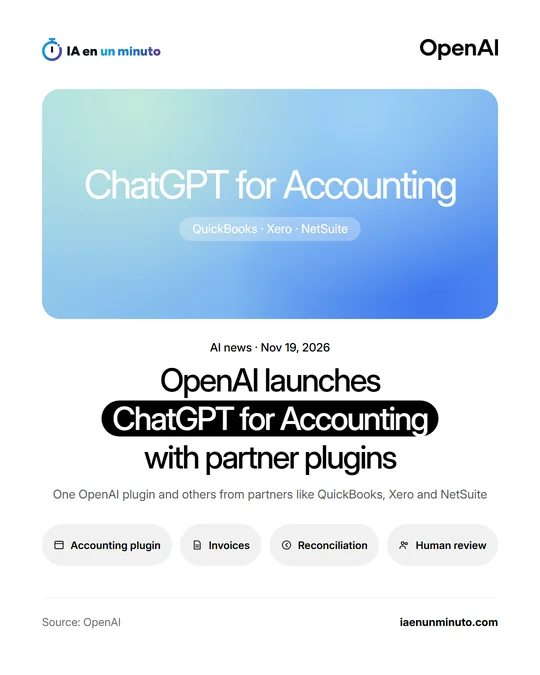
OpenAI launches ChatGPT for Accounting, with connections to accounting software like QuickBooks, Xero and NetSuite
IA en un minuto newsroom · Editor: Jon Elgezabal
In 30 seconds
ChatGPT for Accounting is OpenAI's new offer for bookkeeping, with its own plugin at the center and links to programs many businesses already have. QuickBooks, Xero and NetSuite are on the list of partner apps that can be connected for invoices, bank matching or monthly closes. Crypto Briefing stresses that no change to the data goes through without a person signing off.
On Wednesday, November 18, OpenAI launched ChatGPT for Accounting, a package meant for accounting work inside ChatGPT, as reported by Crypto Briefing. At its core is Accounting, a plugin built by OpenAI itself (a link to an outside program together with the instructions for handling it). The company pitches it as an assistant that operates on each team's accounting software and spreadsheets, covering everything from daily record-keeping to reports and audits, reasoning with the records in view and logging the changes it makes.
Apps from other financial software companies come along with Accounting. The plugin page lists, among others, QuickBooks, Intuit's accounting program; Xero, cloud-based accounting software; NetSuite, Oracle's management system; and Campfire, Rillet, FreshBooks and BILL.
Among its sample uses, OpenAI suggests matching a bank statement with the general ledger for that same month, hunting for broken formulas or double-counted entries in the monthly closing workbook, and explaining the biggest gaps against the budget. Crypto Briefing sums up five main tasks: invoices, bank reconciliation, month-end reports, data entry and audit preparation. The outlet adds that final entries stay under human oversight and that any change to the data has to be confirmed by a person.
The plugin is installed from the ChatGPT directory and used in ChatGPT Work or in Codex. According to OpenAI, whether it can be used hinges on the specific plugin, the subscription plan and how the workspace is set up, and certain connections have to be prepared or approved by an administrator. Crypto Briefing places access in the Work and Business plans and frames it as following ChatGPT for Sales, another sector-specific package. The OpenAI page does not mention a separate price or the countries where it is offered.
Why it matters · analysis and opinion
Until now, using ChatGPT to keep the books meant copying figures from one program to another and trusting whatever came out. With this plugin, the assistant works on the records of the accounting program itself and explains what it touches, which brings it closer to the daily routine of accounting firms and small finance departments. The move fits a recognizable strategy: packages by profession, like the sales one, that turn a general assistant into a trade tool. The signature and the responsibility still belong to whoever keeps the accounts, and changes go through a person. Before connecting it, the sensible step is to decide who approves access and to test it on tasks already solved by hand to compare the result.
Official source: OpenAI · Written with the help of AI: how we make the news
What does it mean for your business? · analysis and opinion
This affects accounting firms, bookkeeping advisors, freelancers who keep their own books, and small businesses with a small finance department that already work with QuickBooks, Xero, NetSuite or another of the partner programs. Anyone using accounting software that is not on the list will not have a direct link, and the plugin is used from ChatGPT Work or from Codex. It is worth checking first whether the plugin appears in the workspace itself, because OpenAI warns that it depends on the plugin, the plan and the configuration, and that some connections require approval from an administrator. Our advice is to start with low-risk tasks, such as checking an accounting file for errors or matching a bank statement against the general ledger, and comparing the result with what has already been done by hand. According to the launch information, data changes and final entries require confirmation from a person; the prudent approach is to always keep that review in place and not leave the judgment on how each transaction is recorded to the tool. The main risk lies in the data: once the accounting program is connected, ChatGPT gains access to invoices, bank transactions and information about customers and suppliers. The sensible approach is to grant access only to what is essential, decide who can approve the connections and, if the accounting of third parties is handled, check that the agreements with those clients allow the use of this type of tool.