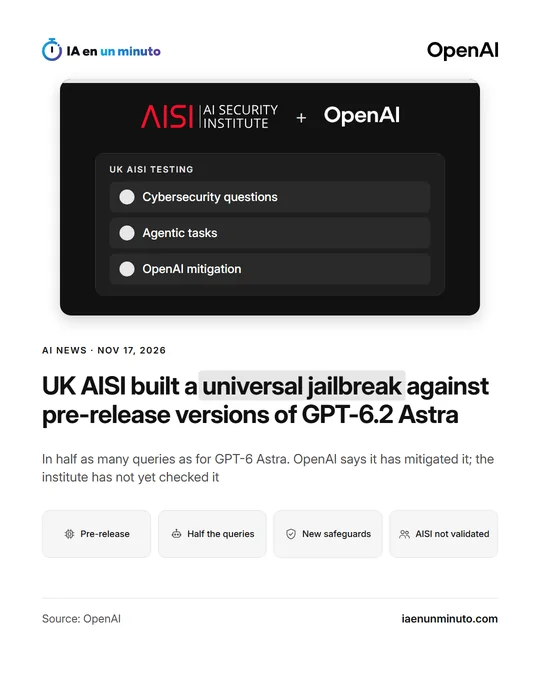
UK AISI built a universal jailbreak against pre-release versions of GPT-6.2 Astra, according to OpenAI's system card
IA en un minuto newsroom · Editor: Jon Elgezabal
In 30 seconds
UK AISI, the UK body that evaluates AI safety, found a way to beat the protective layers around GPT-6.2 Astra on cybersecurity prompts before its release. OpenAI says it has already solved this with new instructions and safeguards in the model. UK AISI has still not verified that the fix works, according to the technical document that comes with the launch.
The UK AI Security Institute (UK AISI) achieved a universal jailbreak against two pre-launch versions of GPT-6.2 Astra, the OpenAI model. A jailbreak is a technique for getting around a model's protections; this one worked on single-turn cybersecurity questions, and an expert at the institute built it with automated attacks.
OpenAI itself describes this in the model's system card, released on November 17 according to The Defiant. On both versions, UK AISI needed half as many queries to the model as with GPT-6 Astra, and one of its experts then carried the attack over to agentic cybersecurity tasks, again at roughly half the cost. The institute found a considerable step back in robustness compared with GPT-6 Astra and says the jailbreak brought out significant agentic cybersecurity capabilities. In its preliminary results it did no better than the top open-source models, although UK AISI thinks the attack could improve a great deal with more work.
OpenAI explains that, following those tests, it changed the model's safety instructions and how its safeguards judge conversations and tool use, and that in internal testing those changes stopped that specific jailbreak. The company believes the regression is mitigated. On November 6 it shared its findings with UK AISI and offered to let it run the evaluation again over three more business days; according to the card, the institute has not yet tried those latest changes on its own.
The card adds that four other private organizations tested the cybersecurity defenses of GPT-6.2 Astra and reported no findings at the high or critical level. What UK AISI found concerns pre-launch versions and OpenAI says it has fixed it, but outside confirmation is still missing.
Why it matters · analysis and opinion
What matters is not only the flaw, but that it is known. A public body testing a model before release and the company publishing the result, including what went wrong, lets customers know where they stand. It also makes clear that a new model can be easier to fool than its predecessor, even if it is more capable. For anyone using GPT-6.2 Astra on sensitive tasks, especially with agents that carry out actions, the prudent course is not to rely only on the provider's protections: limit permissions, review what the agents do and keep an eye on whether the British institute confirms the fix.
Official source: OpenAI · Written with the help of AI: how we make the news