IA en un minutoNewsBusiness and products
The Spanish Government launches the Red Neurona network in Extremadura to bring AI to small businesses
IA en un minuto newsroom · Editor: Jon Elgezabal
In 30 seconds
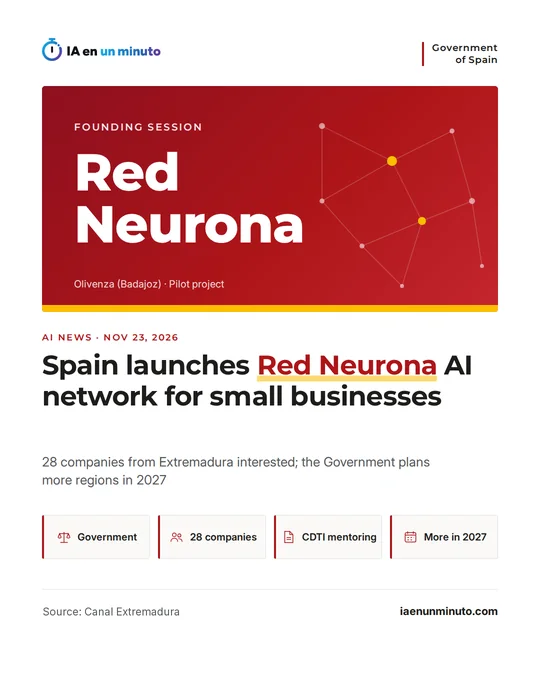
Olivenza (Badajoz) hosted the start of Red Neurona this Monday, the pilot project with which Spain's Government hopes AI will reach small firms. Carlos Cuerpo chaired the event before 28 companies from Extremadura, which will have the CDTI and ICEX as mentors while the CDTI and the ICO put funding on the table. The Government wants to repeat it in other regions during 2027.
Red Neurona, the network through which the Spanish Government wants artificial intelligence to reach small and medium-sized businesses, is now up and running in Extremadura.
It is a network of centers spread across the territory, where AI is shown and put into practice, and in which public bodies and private firms work together. Its founding session took place this Monday, November 23, in Olivenza (Badajoz). It was chaired by Carlos Cuerpo, Spain's First Deputy Prime Minister, and attended by 28 companies from Extremadura that have shown interest in this pilot project. Those firms will be mentored by the Center for Technological Development and Innovation (CDTI) and ICEX. The meeting covered funding from the CDTI and the ICO and, according to Región Digital, the idea of creating "some kind of subsidy" to make these projects cheaper.
Speaking to reporters, Cuerpo said the network tries to bridge the distance between the computing power of the Barcelona supercomputer and what small businesses deal with every day. His example was a tomato company that wants to throw away less produce: it would need robotics, optics and a model able to make sense of information about its own production, so an advanced capability center will be set up to give it prototypes before it decides whether to invest more. He also said AI in small businesses should not come "at the expense of workers".
The Government wants to extend the project to other autonomous regions during 2027. The reports on the launch give neither the number of centers nor the amount of funding.
Why it matters · analysis and opinion
The network does not promise software, but something more useful to a small company: testing before investing, with prototypes built around its specific problem. The tomato example makes this clear, since it combines robotics, vision and the firm's own data, something a small business can hardly put together alone. What is missing to judge it is nearly everything practical: how many centers there will be, how much money, with what requirements and on what timeline. Until that is published, it is a statement of intent with a pilot behind it. Cuerpo's warning about workers also sets the tone: the official message sells AI as a way to produce more with the same staff, not to cut it, something he says the companies themselves asked for.
Source: Canal Extremadura · Written with the help of AI: how we make the news
What does it mean for your business? · analysis and opinion
For now, this only affects small businesses in Extremadura, because the Red Neurona network is a pilot project starting there with 28 companies from Extremadura interested in taking part. Businesses in the rest of Spain cannot yet sign up: the Government plans to expand it to more autonomous regions throughout 2027, without a specific timeline by region. It does not directly affect businesses in Latin America.
For a small business in Extremadura, the practical step is to identify a specific business problem that AI could help solve, such as the example Carlos Cuerpo gave of a tomato company that wants to generate less waste. Our advice is to follow the channels of the CDTI and ICEX, which will mentor the companies, and to organize the data on your own product or process, because the approach involves developing prototypes before scaling up investment. In other regions, it is worth noting down which tasks businesses would like to improve, to arrive with the groundwork already done if the program expands.
As for the cost, the meeting mentioned funding from the CDTI and the ICO, and the Government will try to develop some kind of subsidy, but no amounts or conditions have been published. The prudent approach is not to commit to investments in robotics or custom systems counting on aid that is not yet defined. The Government itself has said it will go step by step in this first stage, identifying what each company needs.