France ranks AI alongside space and nuclear at a Defense Council
IA en un minuto newsroom · Editor: Jon Elgezabal
In 30 seconds
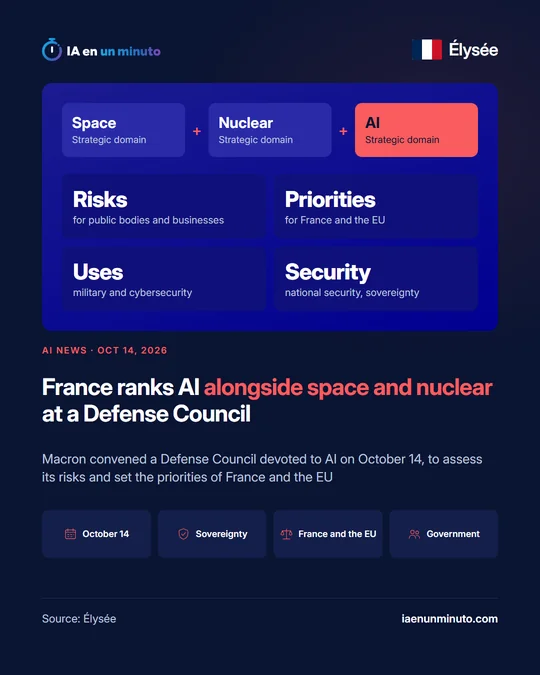
The Élysée has raised artificial intelligence to a matter of national security: Macron devoted a Defense Council to it on October 14, with Lecornu, Vautrin and General Mandon called to the table. Its task was to weigh the dangers for the public sector and for businesses and to mark out priorities for France and for Europe. What gets decided there is classified and need not be made public.
French President Emmanuel Macron chaired a Defense and National Security Council given over entirely to artificial intelligence on Wednesday, October 14. In a statement released that same morning and reported by Clubic, the Élysée describes AI as a "strategic domain that raises major national security and sovereignty issues" and places it on the same level as space and nuclear.
The meeting had two aims: to analyse what risks this technology poses for public administrations and businesses, and to decide France's priorities at home and in Europe. According to Siècle Digital, the focus was on the uses of AI that could have an impact on public administrations, cybersecurity, military systems and the most sensitive infrastructure. The same outlet explains that the armed forces are studying its use to collect and process data, put it to work in operations and help with decision-making.
Those summoned were Prime Minister Sébastien Lecornu, Armed Forces Minister Catherine Vautrin and the Chief of the Defense Staff, General Fabien Mandon. Clubic points out that the defense code tasks this council with guiding the state on deterrence, intelligence, economic security or the response to major crises; AI is not on that list, and the Élysée put it on the agenda on national security grounds. The meetings are prepared by the General Secretariat for Defense and National Security (SGDSN), which oversees the ANSSI cybersecurity agency.
According to Tech Times, what is discussed in this council is classified and there is no obligation to publish its conclusions within any time frame. Siècle Digital and Clubic agree that the meeting had been scheduled long ago and is not a reaction to the recent cyberattacks on supermarket chains. Almost a month earlier, Macron had held another defense council on the hybrid attacks attributed to Russia, according to Clubic.
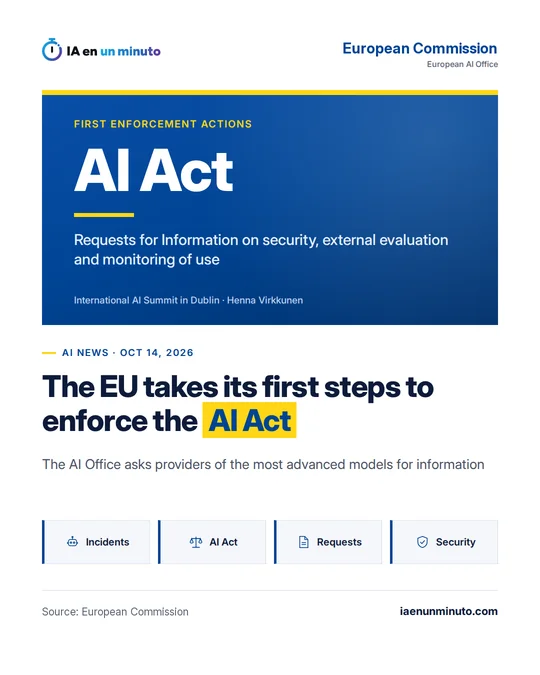
In September, France took the issue to New York, where it held the presidency of the UN Security Council: on September 23 its fifteen members heard from leaders of the main AI labs, among them Sam Altman (OpenAI) and Dario Amodei (Anthropic). Later that month, before Pope Leo XIV, Macron argued for an international organization to keep AI from being concentrated in the hands of a few. Siècle Digital adds that France and Germany want to step up their cooperation on AI security through their specialist bodies.
Why it matters · analysis and opinion
Having a council built for deterrence and intelligence take up AI changes the tone of the debate in France: it stops being only a question of innovation and competitiveness and is handled as a matter of state. For businesses the immediate effect is small, because the conclusions will not be published and any mandatory security rule will first have to go through Parliament. What it does set is a direction: the same country that asks at the UN and before the Vatican that AI should not stay in a few hands now also sees it as a risk to its administrations and its infrastructure. Anyone working with French public bodies or sensitive sectors would do well to watch which of those priorities end up as public rules.
Source: Siècle Digital · Written with the help of AI: how we make the news