Google strengthens message scam detection on Android with Gemini AI
IA en un minuto newsroom · Editor: Jon Elgezabal
In 30 seconds
Google Messages will get an optional mode that sends chats with strangers to Gemini in the cloud to spot scams, with the data encrypted and out of Google's reach. Gemini Nano will vet new links on the phone before they are opened, and scam warnings in chat notifications will spread to more brands. Android will also block, from December, apps that try to divert calls without the user knowing.
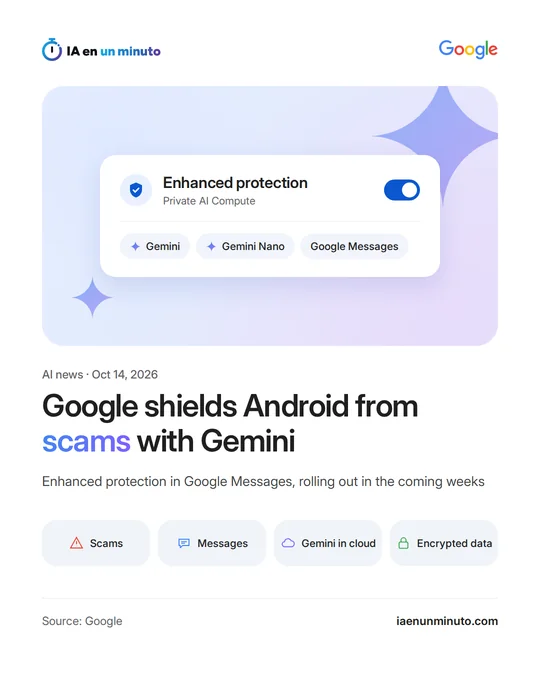
Google unveiled new Android defenses on Wednesday, October 14, on its official blog, aimed at scams that arrive by message and by phone, with Gemini models at their core. The main one is Enhanced protection in Google Messages, an optional security setting that the company will switch on gradually over the coming weeks.
Until now, Scam Detection in Google Messages already flagged classic and conversational scams with an analysis carried out inside the phone. According to Google, that detection and the one in the Phone app mark more than 5 million suspicious calls and messages each month.
With the new setting, when the conversation is with an unknown sender, detection also turns to the most capable Gemini models, which run in the cloud, to interpret the context and work out sooner what the scammer is after, since the intent is often hidden in chats that move slowly. That analysis is done with Private AI Compute: the data travels encrypted and is processed in an isolated space that, according to the company, no one else can see, Google included. In addition, Gemini Nano, the model that runs on the phone itself, will use real-time web signals to judge whether an unknown link is trustworthy before it is tapped; until now, Messages only warned about links already catalogued as malicious. That check will be available on the Pixel 10 and later, the Galaxy S26 series, the Galaxy Z Flip and Z Fold8 and other "select devices". The setting also brings redesigned warnings before opening links sent from numbers that are not in the contacts list, something that was previously limited to some countries or to Android Advanced Protection.
Scam alerts in the notifications of chat apps, so far a Pixel feature, will reach "hundreds of millions" of additional users this year through agreements with manufacturers such as Xiaomi, vivo, realme, OPPO, Motorola and Honor. Google notes that availability will depend on each brand.
On calls, Android will stop apps from secretly switching on call forwarding, a route scammers use to grab one-time codes and take over accounts. And if someone persuades a victim to dial a forwarding code by hand, the system will warn before the code works. As 9to5Google details, this protection arrives in early December on Pixel phones and other "select devices". Separately, the automatic hiding of passwords and payment details during screen sharing, which already worked in native apps, is being extended this month to Chrome and WebView on phones running Android 15 or later.
Why it matters · analysis and opinion
The underlying shift is that Google is willing to move the analysis of private conversations off the phone to gain accuracy, when until now it relied on detection inside the device itself. It offsets this with an encrypted space it says it cannot see, but the setting is optional and has to be switched on: anyone who manages company phones or helps elderly relatives has a concrete reason to check it as soon as it appears. Link checking with Gemini Nano, by contrast, stays on the newest models, so much of the Android fleet will keep relying on lists of already known websites. Blocking call forwarding targets a very specific fraud, the theft of one-time codes, and is a reminder that trusting an account's security to those codes alone is increasingly fragile.
Official source: Google · Written with the help of AI: how we make the news