IA en un minutoNewsBusiness and products
Microsoft signs a 20-year energy deal with NiSource
IA en un minuto newsroom · Editor: Jon Elgezabal
In 30 seconds
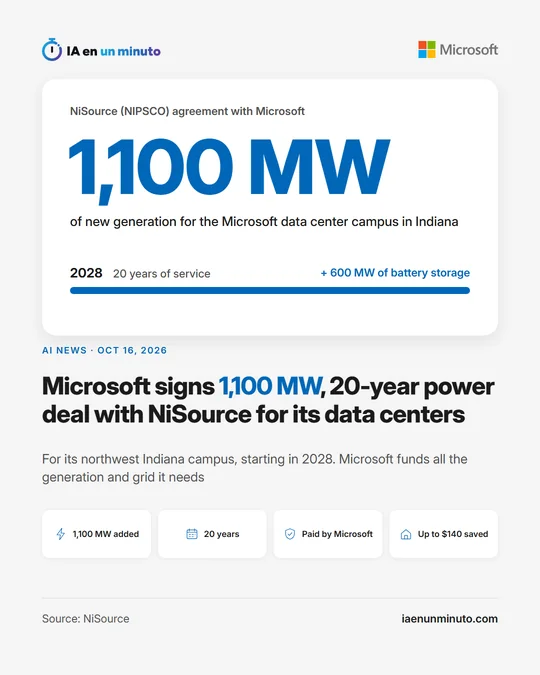
Microsoft will receive electricity from NiSource starting in 2028 for its data centers in Indiana, under a 20-year contract. The utility will add roughly 1,100 MW of new capacity through its GenCo subsidiary, and Microsoft covers all of that generation and the related transmission network. NiSource says its current customers will not take on those costs and raises its savings forecast to roughly $1.75 billion.
NiSource, the utility that operates in northern Indiana (United States) under the NIPSCO brand, has announced a long-term energy agreement with Microsoft. The power is for the data center campus that Microsoft had already unveiled in the northwest of the state, and the plan is for the tech company to start receiving electricity in 2028 under a 20-year contract.
To meet that demand, NiSource will expand generation at GenCo (NiSource Generation Company), the subsidiary it uses to serve new very large consumers, by roughly 1,100 MW. Microsoft pays in full for the generation and power lines its data center needs, and the utility says this keeps the homes and businesses it already supplies from paying the cost of serving it. Those facilities will also be used to improve NIPSCO's transmission network in Indiana.
Alongside this agreement, GenCo has signed a long-term contract for 600 MW of battery storage. The plant will be developed and built by an AGP Group affiliate and is meant to serve several large consumers, not only Microsoft.
With this contract, NiSource raises the savings it expects for its electricity customers over the life of its data center contracts to roughly $1.75 billion, up from the $1.4 billion it projected before. According to the company, that comes to as much as $140 per customer a year. NiSource has roughly 3.3 million gas customers and 500,000 electricity customers in six states.
"Microsoft has always been committed to paying our own way and identifying long-term solutions like this one to ensure that our data centers don't increase electricity prices for other ratepayers," said Jeff Riles, senior director of energy markets at Microsoft. That pledge is the first of five in the "Community-First AI Infrastructure" plan that Microsoft presented on January 13, in which it promised to pay for the transmission and substation upgrades its data centers require and to keep the electricity cost of serving them from falling on households. For NiSource, its president and CEO, Lloyd Yates, said that "affordability is not separate from economic development."
NiSource will give more operational and financial details of the agreement at its third quarter results presentation, scheduled for October 28 according to Benzinga. The release also lists, among the factors that could change its forecasts, obtaining the required regulatory approvals and Microsoft's ability to build its data centers.
Why it matters · analysis and opinion
The deal shows where negotiations between tech companies and utilities are heading: the question is no longer only whether there is energy for AI data centers, but who pays for the capacity that has to be built. Having the large consumer fund the power plants and the lines, and having the utility present it as a saving for households, answers a fear that is growing in many communities, that everyone's bill will rise because of AI. Regulatory approvals are still pending, and it remains to be seen whether that saving really reaches people's bills. For anyone buying cloud services, it is a sign that providers are planning their capacity with decades-long contracts and taking on the cost of the new energy they need as their own.
Official source: NiSource · Written with the help of AI: how we make the news