Class action lawsuit accuses OpenAI of using minors' conversations with ChatGPT to train its AI
IA en un minuto newsroom · Editor: Jon Elgezabal
In 30 seconds
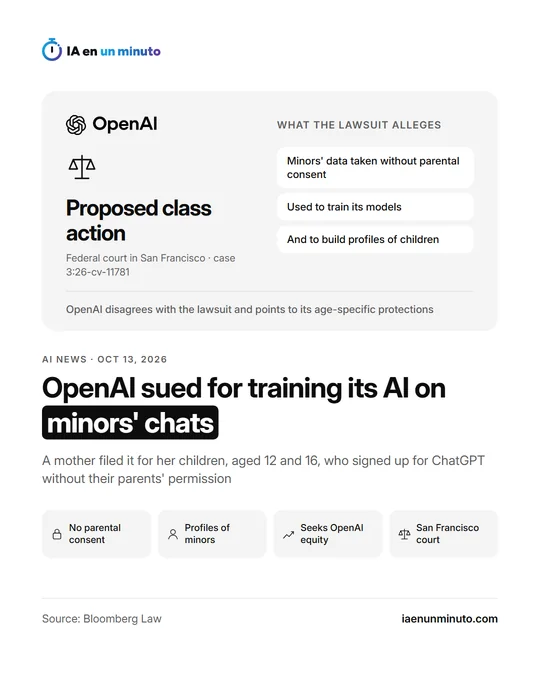
A mother has sued OpenAI in a San Francisco court, acting for her children aged 12 and 16, who signed up for ChatGPT without her say. She claims the company kept sensitive data from millions of children to train its models and profile them, and she wants them to get a portion of OpenAI's equity. The company rejects the lawsuit and the judge has not decided anything yet.
On Tuesday, October 13, a mother filed a class action lawsuit against OpenAI in the federal court in San Francisco on behalf of her two children, a 12-year-old girl and a 16-year-old boy, according to Daily Journal. She argues that ChatGPT, the company's artificial intelligence chatbot, gathered data from minors without their parents' consent and that OpenAI made use of it to train its models.
The filing, which runs to 81 pages according to Independent en Español, states that the company obtained highly sensitive information from millions of children without authorization, health data among it, and used it to train large language models and put together detailed profiles of them. It also faults OpenAI for designing ChatGPT so that children trust it and tell it very personal things. The mother, who asked that her identity not be disclosed, says her children opened their accounts this year without her permission.
OpenAI's rules do not allow accounts for children under 13 and ask for the authorization of parents or guardians up to age 17. The lawsuit says that, when creating the account, it is enough to declare an age over 13. One of the plaintiffs, who appears under a pseudonym, was 12 when she registered; according to the filing, the chatbot asked her age and kept talking with her after she said she had just turned 12.
The lawsuit asks for the case to proceed as a class action for the whole United States, covering those who used ChatGPT as minors, and for each child whose data served to train the models to receive a proportionate part of OpenAI's equity or its equivalent in cash. Bloomberg Law notes that the company is valued at up to $1.4 trillion. It comes months after OpenAI launched ChatGPT for Teens this summer, the default account for teenagers, with more parental controls; the filing argues that those accounts do not protect enough and that, by default, they keep what users write and use it for training.
OpenAI replied in a statement, reported by Bloomberg Law, that it strongly disagrees with a lawsuit it considers misguided and that, in its view, it could push teenagers toward products with fewer protections or less parental control. It added that 90% of the teenagers who use ChatGPT do so each week to learn, get information or build skills, and that on average they spend less than 15 minutes on it. For now these are allegations and the court has not ruled. The case is listed as Doe v. OpenAI Foundation (number 3:26-cv-11781).
Why it matters · analysis and opinion
The underlying question is whether stating an age when signing up is enough when a service stores and reuses what children and teenagers write. If the court accepts that it is not, the bar will rise for any chatbot open to the public, including for companies that build it into educational or customer service apps. The request for compensation in shares, which Bloomberg Law describes as unusual, puts the economic value of training data at the center of the case, beyond privacy. Anyone offering an assistant that minors can reach has reasons to review now how it checks age, which conversations it keeps and whether it uses them for training, without waiting for the ruling.
Source: Bloomberg Law · Written with the help of AI: how we make the news