OpenAI launches GPT-Live-1.1, an update to its voice model with new voices and more natural accents in ChatGPT
IA en un minuto newsroom · Editor: Jon Elgezabal
In 30 seconds
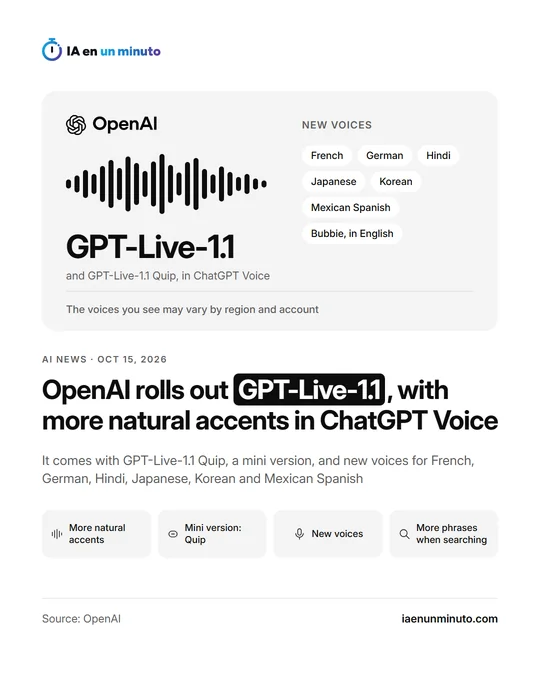
OpenAI has refreshed the model ChatGPT uses to hold voice conversations: GPT-Live-1.1, which comes with a smaller variant called GPT-Live-1.1 Quip. What is new is voices in Mexican Spanish, Korean, Hindi, German, Japanese and French, plus Bubbie in English, and accents that sound less artificial. The change reaches all users and Codex from October 15; the API will get it later, with no date.
OpenAI announced on Thursday, October 15, in its ChatGPT release notes and in a post on X, GPT-Live-1.1, the new version of the model people use to talk to ChatGPT by voice. It comes together with GPT-Live-1.1 Quip, a scaled-down edition of the same model.
The new voices are for Hindi, Korean, Japanese, French, German and Mexican Spanish, and they are joined by Bubbie, another English voice. The company says accents sound more natural across different languages and that the assistant uses more varied short phrases when it signals that it is looking something up; on X it summed this up as less "checking...". The voices each user sees can change depending on their region and account, and they are chosen in ChatGPT's voice settings.
The rollout began that same day for all users. According to the post on X, the update also reaches voice in Codex, OpenAI's programming tool. It will come to developer access (the API) soon, without a specific date; Xataka notes that the previous version has been available there since September.
OpenAI introduced GPT-Live in July, with two versions, GPT-Live-1 and GPT-Live-1 mini. In that announcement it acknowledged that, in some languages, the model could have a non-native accent or gaps in fluency, and that it was still working to improve it. Xataka adds that TechCrunch spotted that problem in a live translation demo, in which the assistant spoke Hindi with a strong American accent.
Why it matters · analysis and opinion
A company fixing within a few months a shortcoming it admitted itself when it launched the product says a lot about the pace of voice as an interface: accent is no longer a cosmetic detail but what decides whether a conversation sounds like a machine or a person. For anyone serving customers in several languages, the list of new voices matters less than its fine print: they depend on region and account, so nobody should assume their team will get them. The decisive step is still missing, the API. Until it arrives, anyone who wants to build a phone or customer service assistant with this improvement will stay on the previous version, and the sensible move is to test it with real speakers before changing anything.
Official source: OpenAI · Written with the help of AI: how we make the news