Inception unveils Mercury 3, a diffusion language model that generates 1,068 tokens per second
IA en un minuto newsroom · Editor: Jon Elgezabal
In 30 seconds
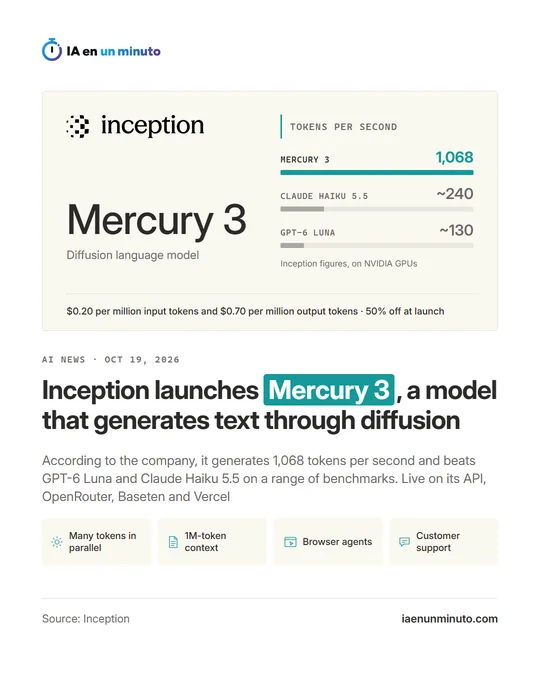
Inception has launched Mercury 3, a language model that does not move forward one piece at a time but turns out many tokens in one go through diffusion. The company says it reaches 1,068 tokens per second and beats GPT-6 Luna and Claude Haiku 5.5 on speed and on several benchmarks. Mercury 3 works with a one-million-token context and can already be used on OpenRouter, Baseten, Vercel and the company's own API.
Inception unveiled Mercury 3, its new diffusion-based language model, on Monday, October 19. As the company explains on its website, other models write text one token at a time (tokens being the chunks of text a model processes), whereas diffusion models produce many tokens at once. Inception describes it as the most capable diffusion model released so far.
Inception says Mercury 3 generates 1,068 tokens per second on NVIDIA GPUs, four to eight times faster than OpenAI's GPT-6 Luna and Anthropic's Claude Haiku 5.5, and that it beats both on several benchmarks. In the results table in the announcement, GPT-6 Luna is listed at roughly 130 tokens per second and Claude Haiku 5.5 at roughly 240.
It is more than 40 times larger than Mercury 1, the company's first model, and can take in one million tokens of context (the text it considers in one go), up from 260,000 for Mercury 2.5.
It is already available through Inception's API (the connection for developers) and via OpenRouter, Baseten and Vercel, and it is compatible with the OpenAI API. It costs $0.20 per million input tokens and $0.70 per million output tokens, although it is 50% off during the launch, at $0.10 and $0.35. Cached tokens cost 90% less than input tokens.
According to Inception, companies that tested it before launch already use it for customer support by voice and chat, data engineering, web navigation and real-time tutoring. The speed and benchmark figures come from Inception itself.
Why it matters · analysis and opinion
What is new here is not just the speed, but that a different technique from the usual one is starting to go head to head with the fast models from OpenAI and Anthropic. If that holds up, anyone building voice assistants, customer support chats or agents that browse the web would have one more way to cut waiting times. What is still missing is for someone outside Inception to repeat its measurements: the speed and quality figures come from the company itself and depend on which tasks are compared. For a technical team, the sensible move is to try it with its own requests, since it plugs in just like the OpenAI API and switching models costs little, and to compare latency, accuracy and cost before taking it into production.
Official source: Inception · Written with the help of AI: how we make the news