China calls for job-risk reviews before approving some AI uses
IA en un minuto newsroom · Editor: Jon Elgezabal
In 30 seconds
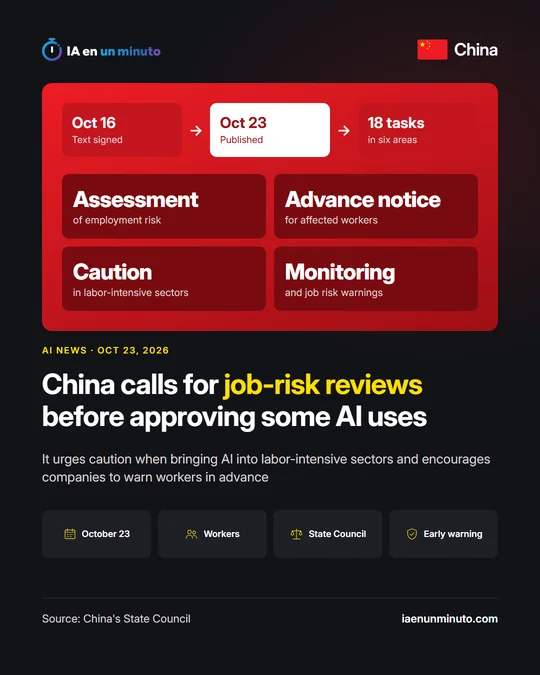
The Chinese government's guidelines provide for studying the labor effect of certain AI projects during their review, when they could hit employment hard. Companies are advised to inform affected staff early before a broad rollout and to help them find new roles. They also call for caution in activities that employ many people, without setting any figures.
On Thursday, October 23, the General Office of China's State Council (the Chinese government) published guidelines on adapting employment to advances in artificial intelligence. The document, dated October 16, is addressed to the governments of provinces, autonomous regions and municipalities and to ministries, carries the State Council's approval and contains 18 tasks grouped into six sections, ranging from creating jobs with AI and training workers to social protection and risk monitoring.
The seventh task deals with AI projects in fields that require authorization to enter the market. If they could have a strong impact on employment, an employment risk assessment will be carried out alongside their review, and the departments involved will have to support workers who need to change roles or jobs. For projects in other fields, that assessment will be done depending on the circumstances of each case.
In sectors that rely on a large workforce, the guidelines ask for prudence over how far, how intensely and how quickly AI is applied, so that it affects the people working in them as little as possible. At the same time, they recommend giving priority to its use in jobs where workers are scarce or the environment is dangerous. Companies are encouraged to try out an unemployment "buffer period": telling affected workers well ahead of time before extending AI at scale and helping them move to another role or job.
The text also seeks to create jobs with AI. It encourages the east of the country to develop the core AI industry and steers the center and west to take on, according to local conditions, activities such as data labeling or smart device manufacturing. It also asks for stronger monitoring and early warnings on employment risk, with data shared across departments.
The risk assessment is part of the review of those projects; advance notice to workers is a recommendation to companies. The guidelines set no figures. According to the Xinhua news agency, China's core AI industry was worth more than 1.2 trillion yuan in 2025, with more than 6,200 companies, and by the end of that year more than 30% of manufacturers with revenue of at least 20 million yuan were already using AI.
Why it matters · analysis and opinion
Employment becomes a criterion in the review of some AI projects, alongside whatever was already examined before letting them reach the market. It is a step with consequences, but still vague: the text does not say what counts as a strong impact, who carries out the assessment or what happens if it goes badly, and it leaves what it asks of companies, such as warning staff in advance, as a mere recommendation. It remains to be seen how ministries and regional governments, to whom the document is addressed, put it into practice. For a company planning large-scale automation in China, the practical consequence is to prepare now a study of the effect on its workers and a plan to redeploy them, because it may end up being part of the approval.
Official source: China's State Council · Written with the help of AI: how we make the news