IA en un minutoNewsBusiness and products
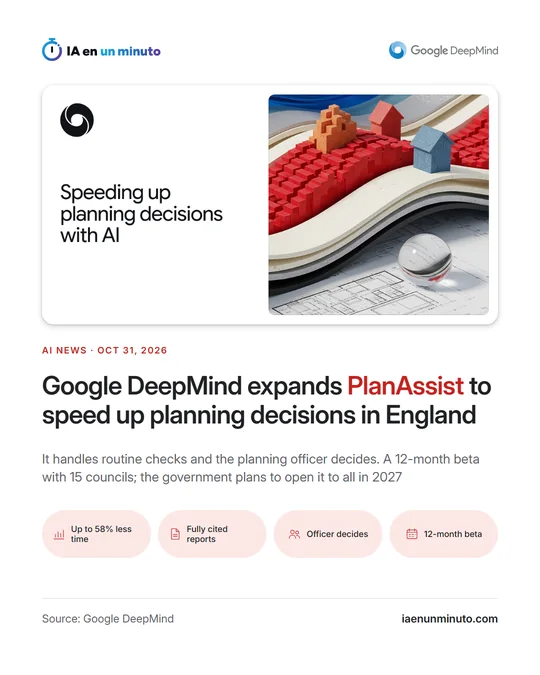
Google DeepMind expands PlanAssist, its AI tool to speed up planning permissions in England
IA en un minuto newsroom · Editor: Jon Elgezabal
In 30 seconds
PlanAssist, Google DeepMind's AI for applications to work on homes, will reach 12 more local authorities in England after cutting assessment time by up to 58% in Barnet, Camden and Dorset. It reviews the paperwork and the rules and proposes a report, but the ruling stays with an officer. A 12-month beta with 15 councils is planned, and the British government wants to extend it to all of them in 2027.
On October 31, Google DeepMind announced that PlanAssist, its AI tool for processing building permit applications, will be offered to 12 more local planning authorities in England. It is built with Gemini and takes care of the routine checks on each application, while the final decision stays with the council's planning officers. In early testing in Barnet, Camden and Dorset, the average time an officer spent on assessing applications for work on a private home fell by up to 58%.
According to the Google DeepMind post, those straightforward applications make up as much as 70% of officers' workload and are usually approved without difficulty, yet they take up a lot of time. For a family, the wait can stretch to months for something as ordinary as converting a loft, adding a conservatory or building an extension. The British government, for its part, has a goal of building 1.5 million new homes by 2029.
The tool works in four steps. First it validates the documents and drawings to confirm the application is complete. Then it checks the case against heritage constraints, such as tree preservation orders, and against local and national planning policy, and looks for any problems or objections already raised, for example by neighbors. Finally, it drafts a report with citations that the officer can change before deciding. The pilot began in June, and more than 70% of the reports generated, which cover things like whether the application meets local rules or whether documents are missing, were approved without any edits.
A 12-month beta with live applications now begins, starting with some of the councils. Twelve more will join in three cohorts, for a total of 15, including metropolitan and rural districts. If testing goes well, the government expects every council in England to be able to use it in 2027, with each assessment reviewed and approved by a qualified planning officer before any decision. The tool was developed by Google DeepMind, the British government, Google Cloud and Faculty. The pilot figures are those DeepMind gives on its blog, which does not say how many applications were assessed.
Why it matters · analysis and opinion
The case is useful because it does not promise that the AI decides: it is given the repetitive part, such as checking that the file is complete, cross-referencing it with the rules and drafting a report with citations, while responsibility stays with a qualified person. That split is what allows testing with real applications without changing who signs off. What is missing, however, is what the announcement does not detail: how many applications were measured, how long officers took to correct the reports that did need changes, and whether the saving holds beyond the simplest applications. The figures are published by the developer itself, so the beta with very different councils will be the most reliable test. For any organization with repetitive procedures, the lesson is to measure first which part of the process is routine before automating it.
Official source: Google DeepMind · Written with the help of AI: how we make the news