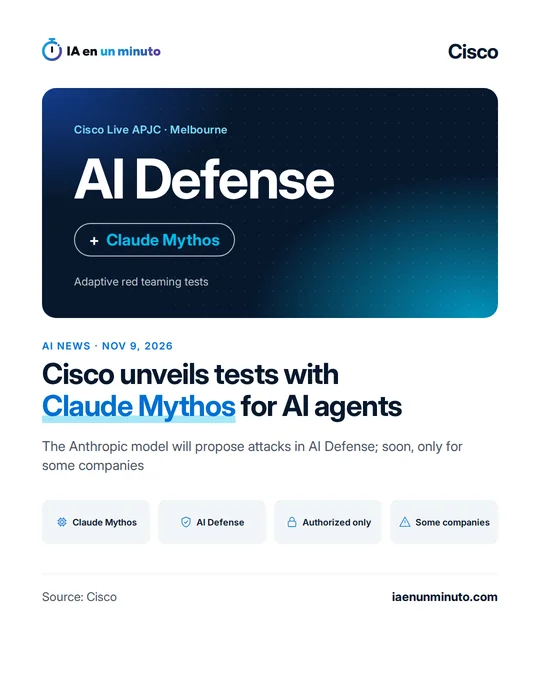
Cisco will add Claude Mythos, the Anthropic model, to AI Defense to run simulated attacks on AI agents, initially only for some companies
IA en un minuto newsroom · Editor: Jon Elgezabal
In 30 seconds
AI Defense, the Cisco security product for AI agents, will add Claude Mythos to its adaptive red teaming tests. The Anthropic model comes up with the attacks and the product launches them, always against registered systems owned by the customer, in sessions that can be halted and with every step audited. It will reach a few companies first, and Cisco sets no date for the rest.
Cisco is going to use an Anthropic model to attack, with permission, its customers' AI agents.
The company announced on November 9, at its Cisco Live APJC event in Melbourne, that it will add Claude Mythos to AI Defense, its security product for AI applications and agents. Anthropic's model will be used in adaptive red teaming tests: simulated attacks, tailored to each system, meant to find its weak points before a real attacker does.
AI Defense launched in January 2025 and, according to Cisco, has since helped hundreds of customers catch serious flaws in models, applications and agents before putting them into production. Until now it has offered two kinds of tests. Standard ones run, in a few minutes, through thousands of risks shared by almost any agent, such as prompt injection, jailbreaks, leaks of sensitive data or harmful output. In adaptive ones, the customer describes in plain words what it wants to check, and the system studies the target, prepares bespoke attacks and switches tactics depending on how it responds. That is where Mythos comes in: it will plan the tests and suggest attack ideas for each case.
Customers will not get open access to the model or be able to instruct it freely. They set the target and what they want to test, and AI Defense runs the operation. It will only act against systems the customer has registered, owns and has cleared for testing, never against the rest of the internet. Each session requires authentication, is tied to a specific person at the company, has a time limit and can be stopped at any moment, and every action is logged for auditing. Cisco adds that these product controls come on top of other safeguards and program-level monitoring.
Standard and adaptive tests are already available, but the Claude Mythos version will arrive soon and only for a few selected companies. Cisco plans to open it later to customers that meet its requirements, without committing to dates, and warns that timing, scope and regions may change.
Why it matters · analysis and opinion
A security vendor putting a frontier model to work attacking agents says a lot about where the sector is heading: the capabilities that cause concern in a criminal's hands are offered to defenders, but locked inside permissions, logs and narrow targets. For companies already connecting agents to their tools and data, the underlying idea holds even if they never use this service: an agent should be tested against attacks designed for it, not only against a generic list of risks. While Mythos reaches a handful of customers, the sensible step is to inventory which agents are running, which systems they can reach and what would happen if someone managed to divert them. That list is what will later show what is worth testing first.
Official source: Cisco · Written with the help of AI: how we make the news