Meta presents Muse Ember, a lightweight and affordable model for AI agent tasks
IA en un minuto newsroom · Editor: Jon Elgezabal
In 30 seconds
Muse Ember is Meta's bet for the repetitive work of agents, such as calling tools or reading long documents, at $0.10 per million input tokens. Its context window reaches one million tokens and it works with text, images, audio and video. Meta says it matches Claude Haiku 5.5 on Artificial Analysis while spending roughly a third as much, although Haiku 5.5 still wins on FrontierCode 2.0.
Meta presents a small model for the tasks that AI agents repeat nonstop.
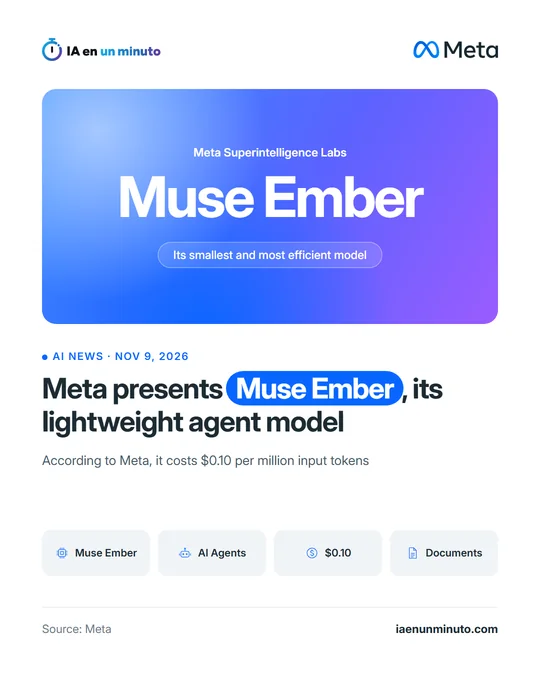
The company unveiled Muse Ember on Monday, November 9, describing it as its smallest and most efficient model. It is meant for the work an agent does over and over throughout the day: calling tools, handling coding subtasks, deciding where each request goes, pulling out data and reading long documents. It is also the first model Meta has trained with Muse Wonder Full, and it completes a lineup in which Muse Wonder takes on the hardest problems and Muse Spark handles coding and agent workflows.
According to Meta, input costs $0.10 for every million tokens, or $0.004 when it is already cached, and output costs $0.50 per million. It accepts up to one million tokens of context and replies of up to 512,000, and it handles text, images, audio and video natively. It is already available as muse-ember-1.0 on the Meta Model API and in Muse Code, as well as on Google Cloud and Oracle Cloud.
To compare it with rivals, Meta relies on the Artificial Analysis Intelligence Index, a leaderboard that gives AI models a common score and works out what each task costs. On that measure, the company says Ember matches the best score of Anthropic's Claude Haiku 5.5 for roughly a third of the cost and beats OpenAI's GPT-6 Luna at every reasoning level. There are caveats: Ember's costs are Meta's estimates at its list price, several tests are the company's internal evaluations, and on FrontierCode 2.0, an Artificial Analysis test built on real engineering tasks, Haiku 5.5 is still ahead, at 34.9% versus Ember's 27.2%.
Meta recommends pairing it with Muse Wonder and sums it up in one line: "Muse Wonder plans, Muse Ember handles the volume." The company says that before launch it assessed the model under its risk framework, covering chemical and biological, cybersecurity and loss-of-control risks, and that it stayed below the high-risk thresholds.
Why it matters · analysis and opinion
The AI price war is no longer fought only over flagship models but over the small ones that do the routine work of agents, where most of the tokens are spent. With Ember, Meta joins Anthropic and OpenAI on that ground and proposes splitting the work: a large model that plans and a cheap one that executes. For anyone already running agents, that split can cut the bill sharply if the subtasks are simple and repetitive. But the comparisons are Meta's own, with estimated costs and several internal tests, so the prudent move is to measure it on the team's real tasks before switching providers, especially in coding, where Anthropic's rival still performs better.
Official source: Meta · Written with the help of AI: how we make the news
What does it mean for your business? · analysis and opinion
This launch matters mainly to small businesses and freelancers in Spain and Latin America that already automate processes with AI agents connected through an API: sorting emails, extracting data from scanned documents or summarizing long reports. For anyone who only uses an AI chat from the browser, nothing changes for now. The announcement does not specify in which countries it is available, so it is worth checking before planning anything.
Our advice is not to switch models just because of the price tag. The $0.10 per million tokens refers to input, and the real cost of an agent also depends on what the model generates and how many times each task is repeated. The prudent approach is to pick a repetitive, well-defined task, run it through the model already in use and through Muse Ember with the same real examples, and compare accuracy and billing over a few days. The division Meta proposes, a large model that sets the criteria and a lightweight one that applies it at volume, can be tested on a small scale without rebuilding the whole system.
The main risk lies in the data. If the agent is going to process meeting recordings, voice notes or documents containing customer or employee information, it is worth reviewing the terms of the provider and where that data is processed before sending it, and starting the tests with material that is not sensitive.