A thousand Claude Fable 5.2 agents formalize Fermat's Last Theorem in 30 hours
IA en un minuto newsroom · Editor: Jon Elgezabal
In 30 seconds
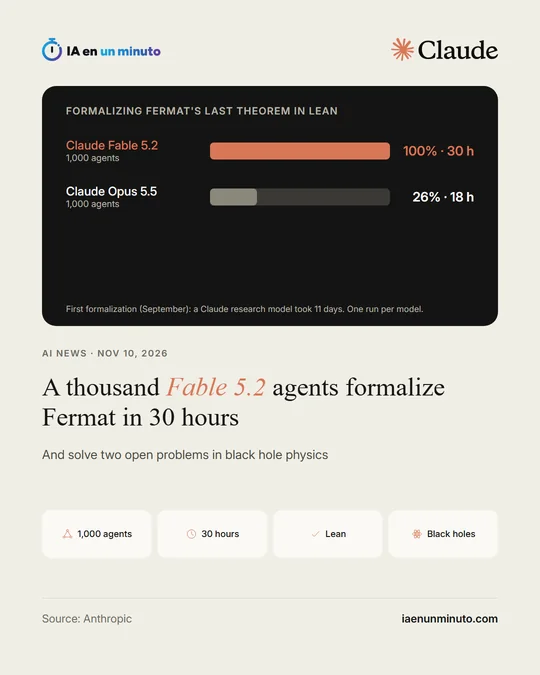
Anthropic credits Fable 5.2, split across 1,000 agents, with a complete Lean formalization of the Fermat proof, finished in 30 hours with very little human help. The first time, in September, a research model similar to Fable 5.1 needed 11 days, and Opus 5.5 stalled at 26% after 18 hours. Fable 5.2 cracked two unsolved questions about black holes as well, now out as preprints.
Working as a team of 1,000 agents, Claude Fable 5.2 needed only 30 hours, and very little human help, to turn the whole proof of Fermat's famous theorem into a formal version, Anthropic says in the post that introduced the model on November 9. Formalizing is not the same as discovering a proof: an existing one is rewritten in Lean, a programming language that lets a computer check each step. The first correct proof of the theorem dates from 1995, by Andrew Wiles.
The yardstick is a project the company made public on September 4, when a computer checked a full proof of Fermat for the first time. That one came from an unreleased research version of Claude, roughly on par with Fable 5.1, running dozens of agents on a custom-built setup with a researcher steering it. It lasted 11 days, and the output filled 13 million lines of Lean, with 29,500 intermediate theorems.
In the new run, Fable 5.2 began with very short instructions, worked out by itself how the agents should coordinate and relied on no math literature at all. Its only guide was a list of the intermediate results it had to reach, which was used to track how far it had got. According to Anthropic, it used about a third as many action tokens as the September effort and wrote a proof one seventh as long. Given an identical team of 1,000 agents, Opus 5.5 had reached 26% after 18 hours and made little headway after that, up to hour 30. Each model was run a single time.
Anthropic adds that Fable 5.2 settled two open questions in theoretical physics, both about black holes and both based on holographic duality: the notion that some universes where gravity exists can be described exactly by a quantum theory that has none. For the first, mostly on its own, it completed a calculation proposed in 2003 that nobody had finished because it was so laborious, and showed that black holes also appear suddenly as very small universes heat up, as had been shown for large ones in 1983. For the second, it pinned down exactly how far a method can go that physicists have relied on for over 15 years to discard possible quantum gravity theories, in a simplified model universe. Both results are out as preprints.
The other big example in the post, the design of three electronic devices with the company Diode, has its own story.
Why it matters · analysis and opinion
The leap is not in the mathematics itself but in verification: checking a long proof is slow and delicate work, and a program that does it beyond doubt can lighten that load. The fact that the model organized itself, without references, points to agents able to sustain long projects with little supervision. What is missing is what any lab result needs: for others to repeat it, with more than one run, and to know what it cost. For a business, the lesson is broader: teams of many agents already perform on long, well-defined tasks, as long as there is an objective way to measure progress, like the list of theorems here.
Official source: Anthropic · Written with the help of AI: how we make the news
What does it mean for your business? · analysis and opinion
For most companies in Spain or Latin America, Fermat's theorem is a long way off, but the method is not. What Anthropic shows is a team of agents working alone for hours toward a huge goal because it has two things: a list of intermediate pieces to achieve and a program that checks, beyond argument, whether each piece is right. That pattern fits more ordinary office and development tasks, such as migrating an old program with a test suite that says whether it still works, or checking documents against fixed rules.
The sensible step, before thinking about many agents, is to ask whether the task has that objective way of checking the result; if it does not, the agents' work cannot be accepted without human review. It is also worth remembering that this is a lab example, with a single run per model and no published cost, so the 30-hour figure says nothing about what repeating it on an in-house project would cost.