Fireworks AI reports a new security breach after an attack on a cloud provider
IA en un minuto newsroom · Editor: Jon Elgezabal
In 30 seconds
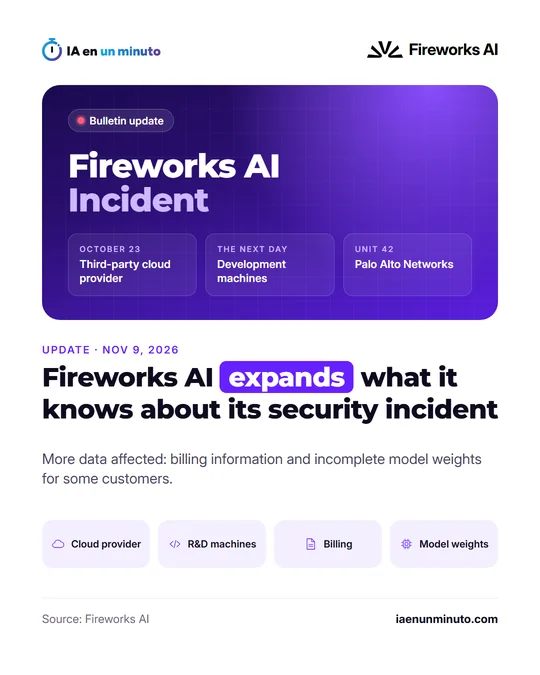
Fireworks AI says an intruder slipped into its R&D systems by exploiting an attack suffered on October 23 by the cloud company that hosted them. Fireworks lists billing records, metadata and, for some customers, datasets and half-trained model weights among what was exposed, though never card numbers. Unit 42, from Palo Alto Networks, is helping with an investigation that is still open.
Fireworks AI, the startup behind a platform for running open AI models, has reported a new security incident. In a bulletin released on Monday, November 9, it says the intruders got into its development machines through an outside cloud provider where they were hosted.
That provider was hit on October 23, and a day later the intruder used it as a way into Fireworks' R&D systems, where it launched a workload without permission. The company says it spotted the activity that same day. The internal application involved gave access to three kinds of information: resource metadata (identifiers, display names, descriptions or creation dates), billing records (addresses, invoices, past payments, credit usage and account balance) and, for some customers, part of their datasets and incomplete model weights. Card numbers were not affected, because Fireworks does not keep them.
According to the company, since October 25 it has found no further sign that the attacker managed to get into the platform its customers use, and it sees no impact on its inference and training services, which keep no data by default. While the investigation goes on, it has turned off the option for customers to upload and download datasets on their own for batch inference and for training based on datasets, and it is contacting the customers whose data was affected.
This is not the first notice. On October 9 the company had already reported a separate incident in which, according to BleepingComputer, the attackers read environment variables in which a limited number of accounts kept API keys and tokens as secrets. Fireworks ties those behind it to a profit-driven cybercrime group involved in "LLMjacking", reselling unauthorized access to language models.
The investigation remains open, and Fireworks is running it with Unit 42, Palo Alto Networks' incident response division. Among the steps taken, the company lists swapping out credentials and service accounts, isolating the affected systems and tighter access to its data stores.
Why it matters · analysis and opinion
The breach came in through a side door: not the platform customers use, but the provider hosting the test machines. It is a reminder that the security of an AI service also depends on third parties the customer neither sees nor chooses. The fact that model weights and training datasets were touched adds a risk specific to this sector, because that is where a company's most valuable work, or the sensitive information used to fine-tune a model, may sit. For Fireworks users, the immediate steps are to check whether they received the notice, renew their API keys and watch for unusual usage, since the group named lives off reselling access to models. And, with more time, to ask every AI provider which other companies handle their data.
Official source: Fireworks AI · Written with the help of AI: how we make the news
What does it mean for your business? · analysis and opinion
This mainly affects small businesses, development studios, and freelancers in Spain and Latin America that use Fireworks AI to run open models such as Llama, Mistral, or Gemma inside their products. Anyone who is not a direct customer but uses apps from other companies that rely on Fireworks depends on what each of those companies tells them. According to the company, the attackers saw resource metadata, billing and shipping addresses, invoice and payment history, account balance and credit usage, plus incomplete model weights and datasets for some customers; not card numbers, because it does not store them.
If you are a customer, it is wise to read any notices the company has sent, change your API keys (the credentials that connect an application to the service), and review your usage history for calls you do not recognize. It is also worth being wary of emails that use that billing information to request payments or bank account changes, because addresses and invoice history make a scam more credible.
Our advice, for any business that connects its tools to AI models through an API: keep keys out of the code, grant them only the permissions they need, and turn on spending alerts. The risk is not small: according to Google's Threat Intelligence Group and Mandiant, the fraudulent use of stolen keys has led to charges of up to one million dollars in the cloud.