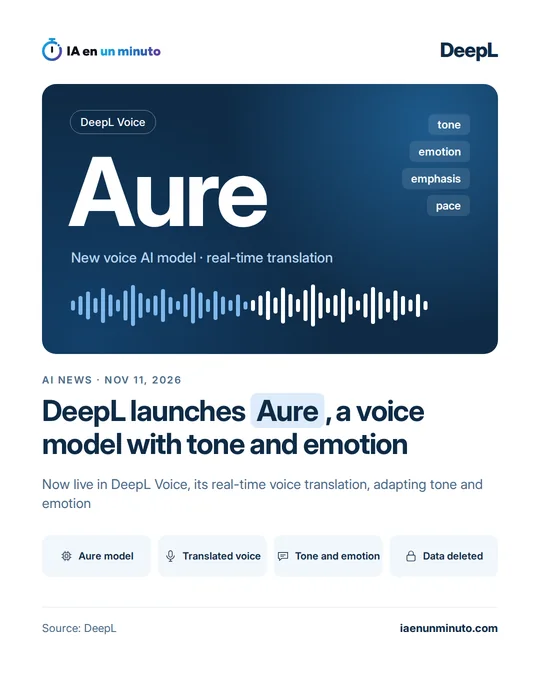
DeepL launches Aure, a voice model that keeps tone and emotion in real-time translation
IA en un minuto newsroom · Editor: Jon Elgezabal
In 30 seconds
Aure is the new DeepL voice model and already translates inside DeepL Voice, tracking sentence by sentence the shifts in tone, emotion, emphasis and pace of the person talking. Before, the translated voice was built from a fixed sample recorded at the start. It works with no settings in video calls, face to face and through the API, in eight languages for now, and DeepL says it wipes transcripts and translations when each session closes.
DeepL has introduced Aure, an AI voice model that now sits behind DeepL Voice, its service for translating spoken conversations in real time. The aim is for the translated voice to do more than repeat the message in another language: it should sound the way the speaker sounds at each moment.
Until now, DeepL Voice built a natural voice from a fixed sample, taken in the first moments of the conversation. According to the company, that told it who was talking, but not how: a static sample cannot keep up with a shift in emotion, emphasis or speed, or with an intonation that runs against the words, as sarcasm does. Aure listens to speech without a break and pairs the original audio with the words already translated to decide how each sentence should be spoken.
DeepL says that to train it, it split three elements apart (the identity of the voice, its prosody and what is being said) so that each can be carried into the other language on its own, and that reinforcement learning polishes the result so it keeps precision and quality and sounds free of accent. The model also has to separate the voice from background noise, echo and distortion. Aure arrives shortly after another DeepL feature that keeps each person's recognisable voice instead of a generic synthetic one.
It switches on by itself, with nothing to set up, in DeepL Voice for online meetings, in DeepL Voice for in-person conversations and in the DeepL voice API. At first it works in eight languages: Spanish, English, French, German, Italian, Portuguese, Japanese and Korean. The company says more will follow, and for the rest DeepL Voice keeps using its earlier voice models. The announcement does not mention pricing.
On data, DeepL states that this technology does not keep meeting transcripts or translations permanently, and that it wipes them from memory when each session ends. That is why Aure has to adapt to every speaker on the fly, even before they finish the sentence.
Among the companies already using DeepL Voice, DeepL names Pioneer Corporation, Inetum, and Aramark and Avendra International. Its chief executive and founder, Jarek Kutylowski, describes it as a step toward a world where "language changes, but the person behind it doesn't".
Why it matters · analysis and opinion
Machine voice translation had already solved the basics, which is saying the same thing in another language; what Aure raises is the bar for how it sounds. If the translated voice respects a pause, an emphasis or a change of mood, it stops sounding flat exactly where that was most noticeable, and for anyone who negotiates, sells or leads teams across languages that can matter as much as getting the words right. It remains to be seen how it holds up outside the launch: with real noise, with people talking over each other or with the sarcasm that DeepL itself gives as an example of what is hard. It will also be worth watching when more languages arrive, because for now the list is short and leaves whole markets out.
Official source: DeepL · Written with the help of AI: how we make the news
What does it mean for your business? · analysis and opinion
This mainly affects freelancers and small businesses in Spain and Latin America that already use DeepL Voice to talk with clients, suppliers or partners in other languages, such as exporters, agencies or firms with clients abroad. Aure runs by itself across online meetings, in-person talks and the voice API, so there is nothing to set up before noticing it. Companies that do not use DeepL Voice see no change for now, and the announcement does not mention prices or plan changes.
Our advice is to test it first in an internal or low-risk conversation and check whether the translated voice gets the intention across well, especially in negotiations, where a misplaced emphasis could cause misunderstandings. It is worth telling the other side that the conversation is being translated with AI. And for figures, deadlines or the terms of an agreement, the safe approach is to confirm them afterward in writing.
On the risk side, DeepL says it does not keep a permanent record of meeting transcripts or translations and that it removes this data from memory once each session ends. Even so, voice counts as personal data, so staff should know when the tool is being used, and this should appear in the privacy information given to clients and employees. Anyone who connects it through the API should check what their own system does with the audio, since that commitment covers what DeepL does, not what is built around it.