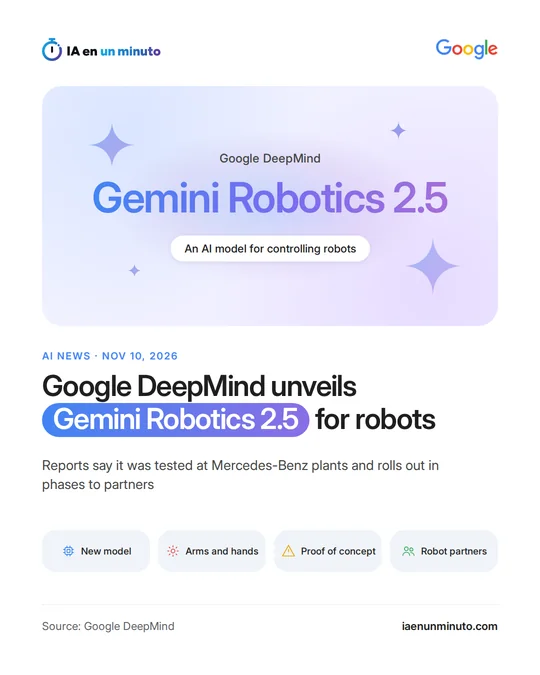
Google DeepMind unveils Gemini Robotics 2.5, an AI model for controlling robots that is rolling out to its robotics partners
IA en un minuto newsroom · Editor: Jon Elgezabal
In 30 seconds
Apollo 2, Apptronik's humanoid, prepared parts at Mercedes-Benz plants in Hungary and Germany guided by Gemini Robotics 2.5, with a 96% success rate. Google DeepMind presents that model as the most capable it has built for moving robot arms and hands based on what they see and the orders they get. DeepMind only hands it to its robotics partners and calls the factory work a proof of concept.
On Tuesday, November 10, Google DeepMind presented Gemini Robotics 2.5, which it describes as its most capable vision-language-action (VLA) model so far. It is the system that interprets what the robot picks up and the instructions it receives in order to move its arms and hands. According to the company, it is being rolled out to its robotics partners, so it is not open to just anyone.
DeepMind has evaluated it on more than 200 different tasks, such as serving food with a pair of tongs, tying a bow on a gift box or pipetting a liquid. Compared with its earlier models, it says success rises by between 30% and 100% depending on the kind of task, and that it finishes between 20% and 30% sooner. It works with very different robots: from Apollo 2, Apptronik's humanoid with a five-fingered hand, to the Franka Duo platform, which uses two-fingered grippers.
The most eye-catching test took place on active Mercedes-Benz production lines in Kecskemét (Hungary) and Sindelfingen (Germany). There, Apollo 2 took metal brackets out of bulk containers and placed them in trays following the parts order each car on the line needs, a repetitive and tiring prep job. It got it right 96% of the time. To do so, a second model, Gemini Robotics ER, kept control of the workflow while Gemini Robotics 2.5 moved the arms and hands.
DeepMind calls it a proof of concept, and BigGo Finance stresses that Google does not present it as the start of a large-scale commercial operation. On safety, the company says the model safely completes 33% more tasks when there are obstacles and 43% more when people are nearby. It has also released ASIMOV-Jailbreak, an open set of tests with disguised dangerous requests. According to DeepMind, much of the progress is down to Gemini 4 Argon, which generates thousands of simulated practice runs from a scene recorded on camera.
Why it matters · analysis and opinion
For years, robots with general-purpose AI have mostly shone in labs and in staged videos; here the setting is a running assembly line. The shift carries weight because the chosen task, repetitive and tiring, is the kind that frees technicians for more complex assembly work. Even so, a proof of concept does not show that the system can last whole shifts, changes of car model or hundreds of different parts, or that it pays off once the robot, integration and maintenance are added up. Limiting access to partners also suggests Google wants to control where it is used before opening it up. For a manufacturer, the sensible move is to follow these pilots closely and wait for results at a larger scale before investing.
Official source: Google DeepMind · Written with the help of AI: how we make the news