Anthropic introduces linked billing in beta on Claude Platform to stop sharing API keys
IA en un minuto newsroom · Editor: Jon Elgezabal
In 30 seconds
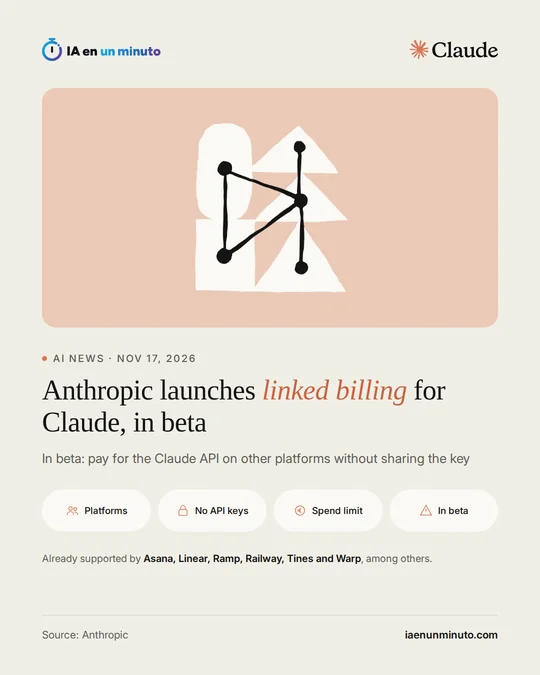
Anthropic is launching in beta a way to pay for Claude from other companies' tools without giving them the API key. Claude Platform charges the customer directly, and the customer authorizes each platform, decides how much it may spend and disconnects it at will. Asana, Ramp, Linear, Tines, Railway and Warp already allow it, though customer settings such as data retention do not apply to those requests.
Anthropic has presented linked billing in beta on Claude Platform, the platform behind the Claude API, according to an announcement on its website. It is a safer alternative to handing API keys to third-party platforms, such as coding agents or automation tools.
Until now, using the Claude API through one of those platforms and paying for it usually meant giving the platform an API key. That key works like a password: whoever holds it can make requests charged to the customer, and the platform is responsible for protecting it.
With linked billing, the customer connects its Claude Platform organization to the platform through a flow hosted by Anthropic and hands over no key. The platform sends the requests and Anthropic charges the customer directly; the customer keeps its usual billing and can draw on a spending commitment it already has with Anthropic or pay as it goes. The customer approves each platform, gives it a spend limit and can unlink it whenever it wants, while the platform sees the usage of each linked customer.
There is a catch: the requests are processed inside the platform's own organization, which means the customer's settings, from data retention to encryption keys and IP allowlists, are not applied.
Warp, Tines, Railway, Ramp, Linear and Asana already support it, among others such as Omni, Gumloop and ClickHouse, according to statements from those companies gathered by Anthropic. Platforms that want to join have to create an app in the Claude Console, and those that already offer it are listed on Claude Marketplace.
Why it matters · analysis and opinion
Sharing an API key with every tool that uses Claude was the convenient fix and also the riskiest one: a leaked key works for anyone until someone cancels it. With this system, Anthropic takes custody of that secret away from the platforms and leaves the permission and the spending cap in the customer's hands. For a company's IT lead, the urgent part is something else: checking which tools hold their own keys today, which already support the link, and whether internal rules depend on settings that do not apply here, such as data retention or IP lists. Since it is in beta, it makes sense to try it first with a single tool before retiring the old keys.
Official source: Anthropic · Written with the help of AI: how we make the news
What does it mean for your business? · analysis and opinion
This mostly affects businesses, technical teams and freelancers in Spain and Latin America that already pay for the Claude API and connect it to third-party tools, such as Asana, Linear, Ramp, Railway, Tines or Warp, among other compatible platforms. Anyone who only uses Claude through its application or website, without touching the API, does not need to do anything. Because the feature is in beta, it is worth treating it as an option that may still change.
In practice, our advice is to start with a simple inventory: note down which services have ever had an Anthropic API key pasted into them. Where the platform already offers linked billing, it is sensible to switch to that system, set a spend limit for each platform and, afterward, remove the keys that are no longer needed. Since each link is approved by the customer, it is worth deciding carefully who in the company can grant it. Payment keeps going to Anthropic, either through the spend commitment already in place or on a pay-as-you-go basis.
The risk lies in the fine print: requests run in the platform's organization, so the customer's own settings, such as IP allowlists, encryption keys or data retention, do not apply. If customer data or confidential information passes through those tools, it is sensible to review each platform's conditions beforehand.