CommBank releases CodeCheck for free, an AI tool to detect vulnerabilities in code
IA en un minuto newsroom · Editor: Jon Elgezabal
In 30 seconds
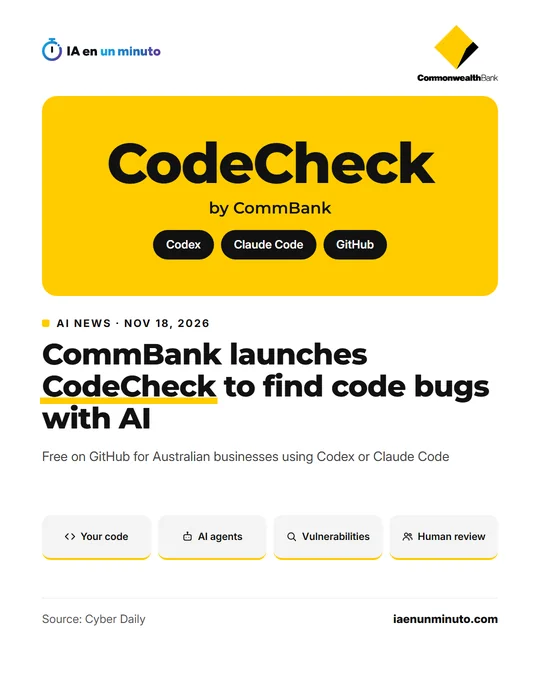
CommBank is offering CodeCheck for free on GitHub, steering Codex or Claude Code while they go through Australian companies' code in search of vulnerabilities. CodeCheck grew out of the system the bank applies to its own software, and a person validates every finding. CommBank warns that it can fail and that the agent and the model may be billed separately.
Commonwealth Bank (CommBank) has launched CodeCheck by CommBank, a free AI cyber security tool meant to help Australian companies spot weaknesses in their software at an earlier stage of development.
The bank's security engineers built it from the system CommBank itself relies on to review its code. It does not work on its own: it sits on top of a coding agent, Anthropic's Claude Code or OpenAI's Codex, and walks it through a fixed procedure to examine the code, look into possible flaws and hand engineers the details of each one. The engineers are the ones who check the findings and choose the next step.
Companies can describe what their application does and how it should behave, which the bank says helps the AI judge each possible flaw better, and they can pick what information they share with the system, as CFOtech Australia details.
It is downloaded from GitHub as a single release and can be adapted within its licence terms. Users need one of those agents, and running the AI model and service may be charged separately. CommBank warns that the tool can get things wrong.
It is meant for organisations that already write software with AI agents, not for those that buy ready-made programs. The bank works with roughly 2.5 billion lines of code and thousands of engineers, according to CFOtech Australia.
Nicola Nicol, CommBank's chief security officer, said the bank wants to pass on what it has learned from using AI to make its software more secure. In comments carried by CFOtech, Nicol added that since cyber criminals are turning to AI more and more, it also has to be used for defence.
Why it matters · analysis and opinion
A bank giving away an internal security tool says a lot about where coding with agents is heading: if AI writes more code, AI is also needed to review it. CodeCheck does not replace anyone; it organises the agent's work so the engineer gets findings that are easier to check. For other companies, the useful part is the method more than the brand: tell the agent what the application does, ask it for the same analysis every time and leave the final word to a person. Because it is a single release, whoever adopts it will have to maintain it on their own, and it is wise to measure model spending before running it on large projects. Anyone who is not an Australian business should read the licence first, since the bank presents the tool for that market.
Source: Cyber Daily · Written with the help of AI: how we make the news
What does it mean for your business? · analysis and opinion
This mainly affects small software companies, development studios and freelance programmers who already work with Codex or Claude Code, the two coding agents that CodeCheck works with. The bank designed it for Australian businesses, so in Spain and Latin America it is prudent to read the licence terms published on GitHub first and check that the use fits. For anyone who does not code or does not use either of those two agents, it does not offer anything for now.
Our advice is to try it out first on a small project that is not in production, to see what kind of findings it offers and how many turn out to be false alarms. It is worth explaining to it what the application does and how it is meant to work, because according to CommBank that context helps make the assessment more relevant, but sharing only what is necessary: no passwords, access keys or customer data. Every alert has to be reviewed by a person before touching the code.
Downloading it costs nothing, although each analysis uses the agent and the AI model, which is paid for separately; it is worth keeping an eye on that usage before running it on a large repository. Since it is a one-time release, the sensible approach is not to expect updates, and the bank itself warns that it can make mistakes: we see it as an additional review, not a substitute for a security audit.