IA en un minutoNewsBusiness and products
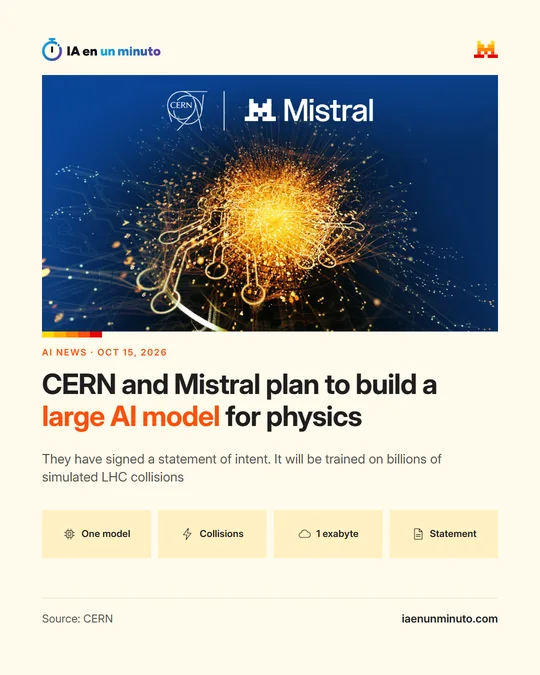
CERN and Mistral sign a statement of intent to build an AI model for particle physics
IA en un minuto newsroom · Editor: Jon Elgezabal
In 30 seconds
Mistral and CERN are jointly preparing a large foundation model for colliders, the Large Physics Model. The plan is to train it on billions of proton crashes recreated in simulation at the LHC, so that a single AI handles reconstructing collisions, recognizing particles and hunting for anomalies. For now there is only a statement of intent, with no announced schedule or budget.
CERN, the European Laboratory for Particle Physics, announced on Thursday, October 15, that it has signed a statement of intent with Mistral for a long-term strategic partnership. Mistral, headquartered in France, builds large-scale AI models, many of them open-weight, and the agreement centers on foundation models (general models that can handle many tasks) applied to scientific discovery.
The centerpiece is a single Large Physics Model, a large pretrained physics model that, according to CERN, would be the first foundation model for collider physics. It will learn from billions of simulated proton collisions at the Large Hadron Collider (LHC), the biggest and most powerful particle accelerator in the world.
The aim is for that model to cover several jobs at once: reconstructing collisions, identifying particles, flagging unexpected signals and assessing designs for future detectors. Today reconstruction is handled by a chain of specialized algorithms that gradually turn detector signals into the particles used in analyses. Machine learning already improves several of those steps individually, and the idea is for one model to learn the entire chain.
CERN holds one of the largest volumes of scientific data on the planet: about one exabyte (one million terabytes) of experimental LHC data stored so far. The number of collisions will grow tenfold with the HL-LHC, the upgraded version of the accelerator, which is expected to start running around 2030.
"We are partnering with Mistral, a leading European AI company, to advance AI capabilities that can serve the whole physics community and be shared," said Enrica Porcari, CERN's Chief Information Officer. Johannes Brandstetter, Vice-President of AI for Engineering at Mistral, described the opportunity "to push the frontiers of high-energy physics."
The first field of work will be high-energy physics, although CERN's announcement adds that the partnership could later serve other sciences. For now it is a statement of intent: the announcement gives no timeline or budget for the model.
Why it matters · analysis and opinion
What is new is not using machine learning in physics, which has been improving isolated parts of the analysis for years, but trying to have a general model take over the whole chain. It would be a demanding test for AI: in particle physics every result is checked with a rigor few sectors apply. It also says something about the European market, where a public laboratory picks a company from the continent for a long-haul project. But almost everything is still to be defined: there is no schedule or budget, and it is not known whether the model will be opened to other research groups or how the work will be split between the two partners. Until a first evaluated version exists, it is an intention with a heavyweight partner, not a tool.
Official source: CERN · Written with the help of AI: how we make the news