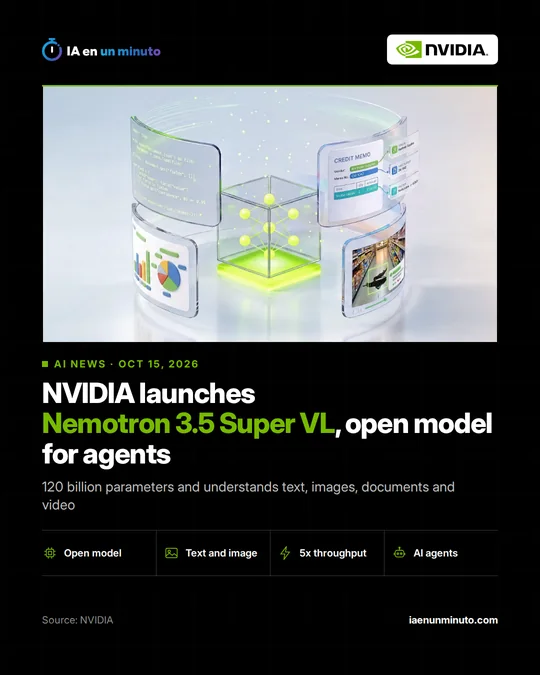
NVIDIA launches Nemotron 3.5 Super VL, an open multimodal model for agents
IA en un minuto newsroom · Editor: Jon Elgezabal
In 30 seconds
NVIDIA has unveiled an open-weight model for enterprise agents, Nemotron 3.5 Super VL, which can read text, images, documents and video. Of its 120 billion parameters it only uses 12 billion per token, and the company claims that on one GPU it runs up to 5x faster than open rivals of its size. Scale AI, Ramp and AI21 are already adapting it to their own tasks.
On Thursday, October 15, NVIDIA introduced Nemotron 3.5 Super VL on its developer blog: an open, customizable model designed for enterprise agents that handle text, images, documents and video at the same time.
It is built on a mixture-of-experts (MoE) design: it has 120 billion parameters, but only 12 billion are at work on each token. NVIDIA says that on a single GPU it achieves up to 5x more throughput (processing capacity) on agentic tasks than other open models in its class; according to its chart, it tops 600 tokens per second on the Artificial Analysis index with Baseten's service. The model was distilled from Nemotron 3 Ultra, the largest in the family, and beats it on the Hermes Bench and LangChain agent tests: 63.44% versus 56.33% and 87.05% versus 84.3%.
The idea is for one model to reason, follow instructions and call tools without having to set up a text model and a vision model separately, or hand context back and forth between them. Its visual training spans charts, tables, text recognition (OCR), multipage documents and video. On CharXiv, a chart-reading test, it scores 80.8%, where Nemotron 3 Nano Omni stopped at 63%.
Each company can post-train it with its own data, tools and rules through NVIDIA NeMo, the company's open libraries. Along with the model, NVIDIA is publishing open datasets on Hugging Face (among them 40 vision-language sets) plus base, post-trained and 4-bit quantized (NVFP4) versions, with their training recipes. The weights can be installed on in-house machines, in data centers or in the cloud, and the model is also offered hosted on OpenRouter and as an NVIDIA NIM microservice. The announcement does not mention pricing.
Among the first customers, Scale AI has tuned it to process vendor credits at the studio Skydance and expects the inference cost of that task to drop 40-fold; Ramp uses it to turn photos of receipts into structured data, and AI21 and Alice have adapted it to threat and vulnerability analysis, with 41% higher accuracy. According to The Decoder, NVIDIA launched two smaller models for local machines at the same time, Nemotron 3.5 Bolt 74B-A9B and Bolt E4B (the latter later in October), and on the overall Artificial Analysis index Super VL sits far behind the best closed models.
Why it matters · analysis and opinion
NVIDIA's bet is not to compete with the most powerful closed models, which this one trails by a wide margin, but with the cost of keeping agents working nonstop. For anyone already processing invoices, contracts or receipts, merging vision and text in a single model simplifies the architecture and cuts the handoffs where an agent loses context. Open weights and largely open training data make it possible to tune it with sensitive information without letting it leave the building, which matters in banking or cybersecurity. What remains to be seen is how it performs outside the showroom: almost all the figures come from NVIDIA, measured on its own hardware, and some of the customer cases are projections. Before switching models, it is worth testing it on your own documents.
Official source: NVIDIA · Written with the help of AI: how we make the news