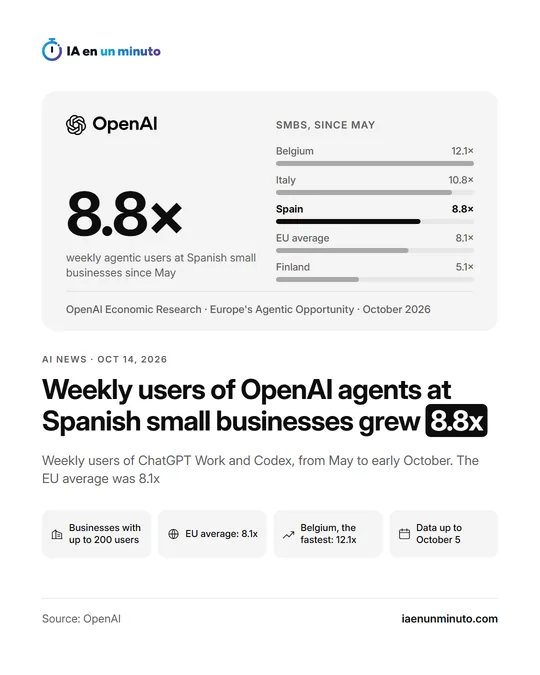
Weekly users of OpenAI agents at Spanish small businesses grew 8.8x
IA en un minuto newsroom · Editor: Jon Elgezabal
In 30 seconds
According to an OpenAI report dated October 14, the number of people using Codex and ChatGPT Work each week at Spanish small firms has risen 8.8 times since early May, against an EU average of 8.1. Belgium leads that growth with 12.1. In company accounts, however, Spain is among the countries where the least text goes through these tools: 30%, 24th of 27.
OpenAI's economic research team published a report on Wednesday, October 14, on how the use of AI agents is growing among companies in the European Union, with figures by country. According to its data, at small and medium businesses in Spain, weekly users of ChatGPT Work and Codex, the two tools OpenAI's agents use to carry out tasks, were 8.8 times higher in the week of September 29 to October 5, 2026 than in the week of May 1 to 7. The study counts as a small or medium business any company with up to 200 associated users.
Across small and medium businesses in the EU as a whole, the increase was 8.1x. By country, Belgium (12.1x), Italy (10.8x) and Luxembourg (10.0x) grew the most and Finland (5.1x) the least: all of them went past 5 times their May level. According to OpenAI, much of that growth came after the introduction of ChatGPT Work, which launched in July 2026.
The picture changes in ChatGPT Enterprise and Business accounts, where the report measures what share of output tokens (the text the models generate) goes through Codex and ChatGPT Work. In September, at Spanish companies it was 30%, which puts Spain 24th of the 27 countries. Lithuania tops the list with 85%, and only Portugal (29%), Austria (26%) and Slovenia (22%) come in lower.
For the EU as a whole, those two tools now produce more than half of the output tokens of the ChatGPT Enterprise customers in the sample. The report also notes that in 2025, 20% of EU companies with at least 10 employees were using AI, up from 13.5% in 2024.
Another part of the study compares how intensively AI is used. It calls frontier firms the top 10% by output tokens per active user. In September, frontier firms in the EU generated over four times as much per user as typical EU firms, but frontier firms outside the EU generated more than double what the European ones did. EU companies made up close to 10% of frontier firms worldwide, and North American ones roughly 65%.
Using a sample of messages from the Free, Go, Plus and Pro plans in the third quarter, the report also looks for the most distinctive work task in each country compared with the rest of the EU. In Spain, as in Hungary and Slovakia, it is developing educational programs, plans or procedures.
All the figures refer to people who use OpenAI products, not to companies in general, and the report does not give the number of users in any country, only how much it has grown.
Why it matters · analysis and opinion
A fast rise in the number of people trying agents does not mean that work already goes through them, and in Spain the report shows exactly that distance: small businesses are signing up quickly, but in company accounts most of the text the models generate still comes from the usual chat, not from delegated tasks. It should be read with caution, because these are a vendor's figures about its own customers, with no absolute numbers and no comparison with other tools. Even so, it points to where the room for growth lies: in moving from trying things out to handing over complete, repeated jobs, such as preparing documents or reviewing files, with a clear way to check the result. It is the same difference the study sees between the companies that get the most out of AI and the rest.
Official source: OpenAI · Written with the help of AI: how we make the news